
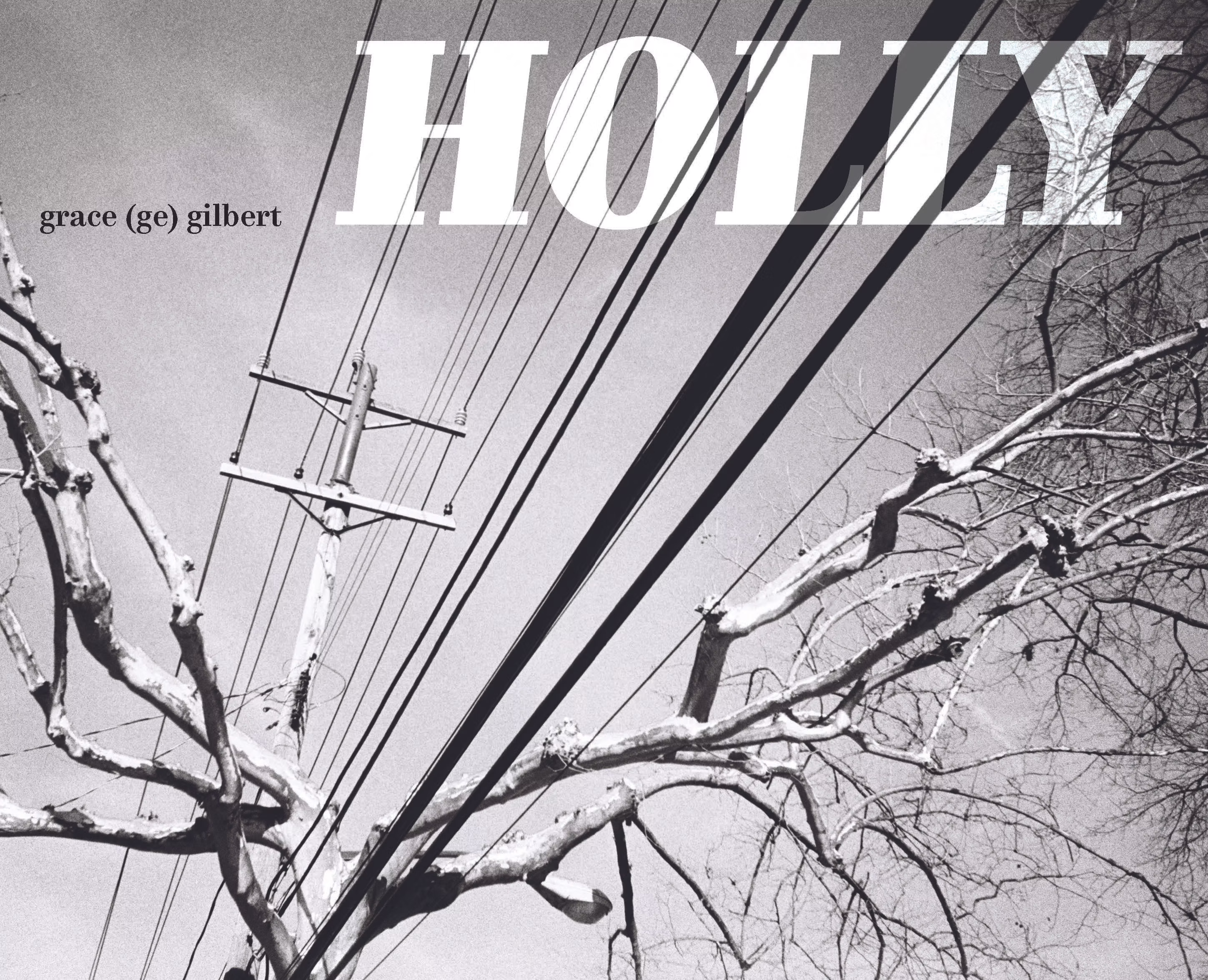
grace (ge) gilbert’s debut collection of poetry, Holly, published by YesYes Books in June 2026, is a chronicle of familial trauma and its aftermaths in the vein of Anne Carson’s Nox and Diana Khoi Nguyen’s Ghost of. Holly was Gilbert’s grandmother, who was murdered at age 34 in Watertown, New York. Gilbert’s father was the one who found her: on the floor of their kitchen, strangled with a pair of pantyhose and shot in the face and the neck.
The primary focus of the collection is the traumatic impact Holly’s murder had on Gilbert’s family. A particularly striking example comes early in the collection, where the speaker recalls being a child and watching the father anoint a photograph of Holly with holy water:
As a child, the speaker cannot quite understand the meaning of the anointment but recognizes its importance. Despite this recognition, the traumatic rupture between father and daughter is total and implicit, evident as the speaker shrinks themself “in the stairwell,” unsure of what questions to ask, or whether it would be okay to ask them at all. This silence defines the relationship, reinforced by the white space between the stanzas.
 The speaker’s attempts at connection exist in brief moments, formally communicated by the scanned slips of paper that make up the poems, and apparent across the fragments is the speaker’s natural need to be acknowledged and loved by the father, to be brought into the fold of understanding. Longer sections of text offer stark, confessional portraits of the speaker’s grief, of not being loved in the way they needed:
 ***
***
Gilbert’s use of collage has its roots in family history as well. Their mother is an avid scrapbooker, who Gilbert cites as their greatest inspiration for Holly’s visual form. Scrapbooking, of course, is one of many craft-based art practices gendered as feminine and often taken less seriously than “fine arts” such as sculpture or painting. Gilbert told me they believe the lack of reverence is partly due to its accessibility: you do not need any special tools or much technical training to make a collage. In fact, much of the beauty of collage comes from its ragged edges. This is especially true in Gilbert’s collection. For the scanned text of the poems, Gilbert used Lokta paper—a kind of handmade paper from Nepal. Scans reveal bits of unmixed pulp, random folds, and stains; hand-cut stanzas have bowed and uneven edges. Both the substance of the paper and its formatting convey the speaker’s own haphazard journey of making sense of their family history from what is leftover, from “the things we must keep but have nowhere to put on display”: imperfection is the point, the way in to understanding:
 In “HOLLY AS MOURNING AND MELANCHOLY,” a long poem at the book’s center, the speaker turns their attention to gender and familial roles, considering what it is to perform the role of the middle daughter, “so high off the ground it beguiled me … what my mother called the ‘nut.’” The speaker acts a “tomboy,” taking to sports and competition, in order to forge connection with the father. “Being a boy kept me … in closer ranks with my father than my sisters,” the speaker admits while acknowledging that “[these] memories of tenderness … with my father revolve around learning the proper ways to perform.” The implicit question here, getting at the Freud essay the title references, is how authentic can a relationship be if it is contingent on the performance of gender? The speaker recalls the father saying proudly that “grace runs like a boy,” but what does it mean to be loved for someone that you are merely like, rather than who you are? It means melancholy, navigating the space between what is and what is expected.
Eventually, the pendulum of gender performance swings in a different direction, though the melancholy remains:
“as I got older, I became less of a tomboy and more a signifier of something uncomfortable for others… I learned the term lezzy, a seemingly secret and terrible insult… // I learned to stabilize through self-loathing, through mimicry… // I grew out and straightened my hair, tossed my father’s caps… // it was a deep something I felt when I saw what I’d become. For the rest of my performance as a girl I could hardly look.”
The above stanzas are followed by a collage composed of a questionnaire from the 1986 study “Children Who Witness Parental Murder”: Photographs of the speaker’s father overlay the questionnaire, though the cut-out eyes make them relatively anonymous and, most importantly, unable to return the gaze of the reader, placing the reader in a similar position to the speaker’s, striving for unconditional regard. The father figures are juxtaposed with three drawn and painted silhouettes on the left-hand side, ghostly and ambiguous by comparison: perhaps three daughters shouldering the weight of the father’s trauma. The silhouettes lack gendered markers, especially when compared with the obvious masculinity in the photographs, the prominent Adam’s apple, faint facial hair, and polo shirts. Their vacuity speaks to the melancholia of compulsory gendering, and, more generally, to the most pervasive theme of the collection: the way in which the family members—in both their bodies and minds—empty themselves, transforming into containers for the unexplored pain and anger of the men in their lives. This emptying, which had its beginning in the violent end of one woman’s life, carries on through the generations, shouldered by mothers, aunts, and daughters, and is, perhaps, finally laid to rest in Holly.
