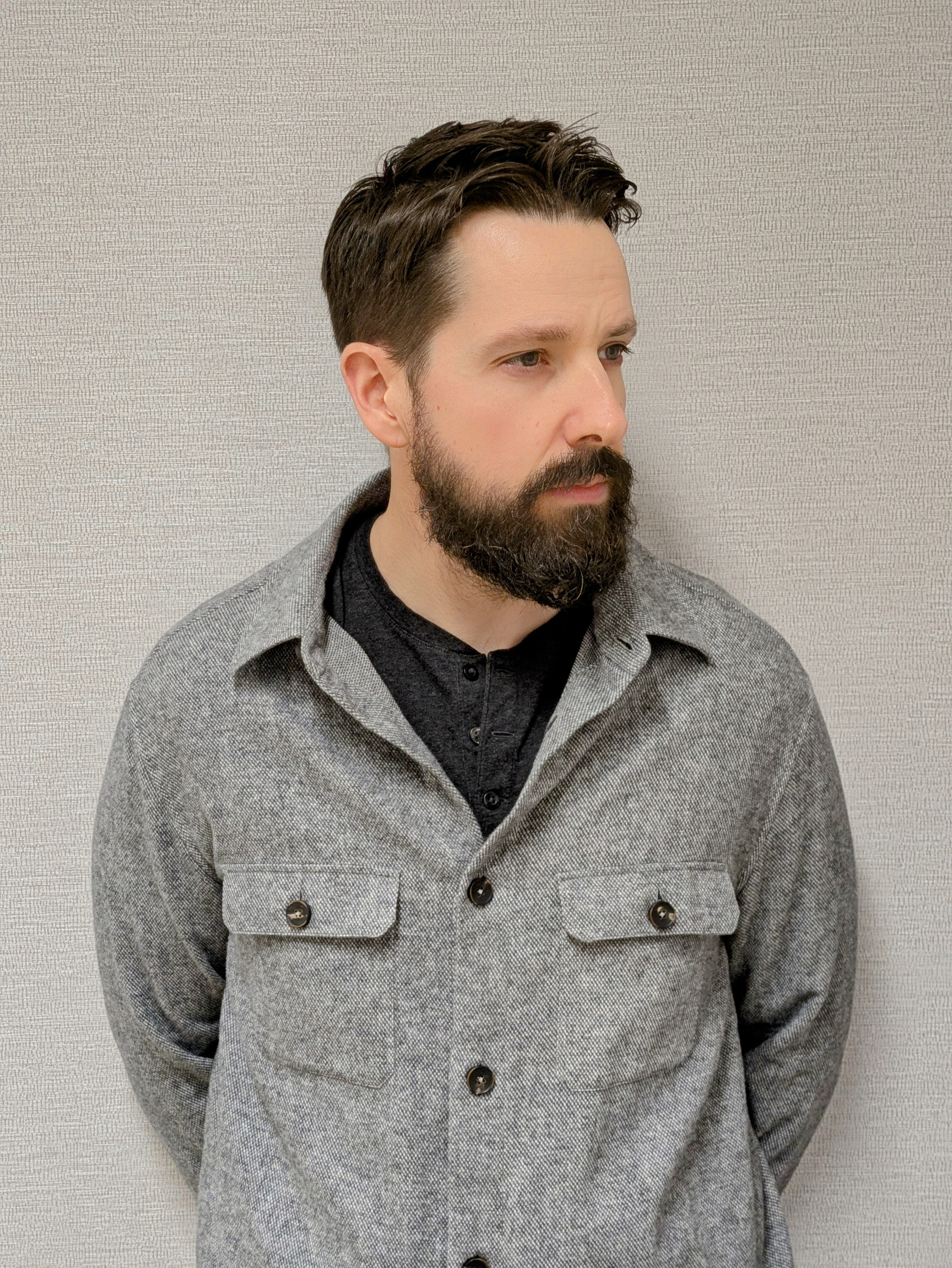
Julie Buntin’s new novel, Famous Men, is recently out from Random House. She’s also the author of Marlena (Holt, 2017)—a finalist for the NBCC John Leonard Prize—and the co-editor of Notes to New Mothers, a collection of dispatches from postpartum life by sixty-five writers and artists. Her writing has appeared in The Atlantic, Harper’s, and the New York Times, among other publications, and has been supported by the MacDowell Colony, the Bread Loaf Writers’ Conference, and the New York Community Trust. Formerly an editor and director of writing programs at Catapult, she’s an assistant professor at the University of Michigan, and has taught creative writing at NYU, Columbia University, Marymount Manhattan College, and the Yale Writer’s Workshop.
***
Julie Buntin’s Famous Men is certain to start conversations. The novel follows Wilhelmina, a young writer who pushes her way into the orbit of Nathaniel, a legendary author, only to find herself quickly subsumed by it. The setup might sound familiar, but Buntin writes their relationship with such complexity and ambiguity that Famous Men becomes one of the most fascinating books of the year.
I spoke with Buntin over Zoom for more than an hour about breaking the “rules” of fiction, writing into ambiguity without fear, and what it means to make art in a world where the art itself rarely pays the bills.
***
Michael Costaris: I love the way this book opens by doing what every single craft book tells writers not to do: it gives us a full, long chapter of backstory on Will. But not only does it work, to me it felt essential. I’m not sure the rest of the novel would function the way it does without that specific context. When did you land on that opening and was there any pushback from early readers, editors, or yourself?
Julie Buntin: Ha, yes! It is kind of a taboo move. I landed on it pretty early. I always thought of this book as Will’s story, not just the story of her and Nathaniel, but the story of how she came to be the person she is, and was interested in tracing her life over a long period of time—it felt sort of sneaky and subversive to me, to redirect the reader’s attention right away to her origins instead of diving into the relationship that’s the crux of the plot. And I tried to shape that chapter so that it feels leading, and propulsive, burying in it some questions that are very much a part of the front story—about Will’s father, about her mother and what she knows.
Writing this also coincided with starting my work as a full-time teacher of creative writing, and I was ingesting a lot of craft texts, and thinking about all the ideas I took for granted from my own writing education about what good fiction looks like. I started realizing there’s a real danger in giving early writers convincing-sounding advice about how to proceed. You can influence them too strongly. You can cut off possibilities before they even fully emerge.
When I was coming up in my MFA program, whether this is fair to them or not, I really felt like what my teachers said was law—that is one of the things this book is responding to, this question of what exactly we are teaching when we teach people how to be writers? Who decides what craft expectations are, what good fiction is, and where do these ideas come from?
I was thinking while writing, what advice do I want to resist with this novel? To play around with?
MC: Did the second-person section arise from that impulse?
JB: Yes. We get so many applications in our MFA program that include a second-person story—sometimes they are great, sometimes less so, but they often have a kind of same-y quality, something about the perspective lends itself to that. After a couple of years, whenever I saw one, I’d think, Oh my God, no, not second person. But then, whenever my brain starts to categorically shut down an option for what fiction can do, another part of me is like, Okay, let me try it.
MC: And the section—which condenses a long stretch of time into a short chapter—I don’t think would have worked in first person.
JB: I had this problem to solve with the draft—I needed a time jump, but when I tried just cutting, I felt the absence too loudly—what happened needed to be gestured to, needed to be felt. I played around with a couple of other things, but when I hit on second-person as an option, it broke the section open, energetically. And, of course, it was fun—again, maybe because I felt like I was “breaking” a rule. What does second-person do well? It can move you through time. It can show a character who’s dissociating in some way from themselves—like Will. It does telling really efficiently.
MC: And Will has gone through this strict mentorship with Nathaniel, internalized all of his rules. Were you thinking about Will as a writer, what she would do, when making these craft choices?
JB: Yes. I was also playing with this idea that Famous Men itself might look a little bit like a writer’s biography for a person who wouldn’t normally get one. For that person, that writer, on the margins of the star’s story. This isn’t based on these stories at all, but I was fascinated by these figures like Janis Bellow, Saul Bellow’s wife at the end of his life, who was forty years younger and had been his secretary, and was also a brilliant scholar. They had a child when he was in his eighties. Françoise Gilot, who was in a relationship with Picasso when she was twenty-something and he was in his sixties, and who was a fabulous painter, a fascinating person, but whose story is often kind of told by underscoring her proximity to him—how she was the only woman who left him, for example.
MC: The majority of the novel is in first-person narration. Will, as a narrator, is very elastic—the present version of herself is there even while narrating the past. How conscious were you of where Will was in the present as she narrated the story? Emotionally as well as temporally.
JB: My first book was in first person too, and I actually had to do more of that kind of work with Marlena because I didn’t know, until late in that project, the place from where my narrator was telling it. Because I learned something from writing that book, I was more confident in Will’s first person. I knew exactly where she was at the end from very early on. I always had that sense that Will was looking back from a different place. There would be this elasticity in her first-person narration, this ability to comment on what was happening and offer some interpretation. I didn’t want too much of it, because it can slow things down, but in places where it felt necessary, I knew it was an available facet of her voice.
MC: Will’s voice is also infused with judgment—it feels like her re-evaluation of the past through the standards of the present—yet she never quite condemns Nathaniel in the way readers might expect. How did you approach maintaining the ambiguity of their relationship without allowing that ambiguity to become an endorsement?
JB: My hope is that the novel provokes uncomfortable questions, and that people disagree about it. I don’t write novels to say one particular thing, so it was important to me that Will and Nathaniel’s relationship not be reducible to one thing. However you want to interpret it, they have a relationship. They’re connected in ways that go beyond economics, and beyond Will giving herself over to Nathaniel’s wants. There is something between them that resembles love in places, however we want to judge that. Will doesn’t know what to make of it herself.
MC: Was it frightening to write that kind of ambiguity? The nuance comes through on the page, but we’ve seen how easily a book can be flattened or misread, especially online, regardless of your intention. Was that a concern for you?
JB: Not when I was actively writing, but definitely when I put the book down, or had to read from it, or something. What will people think? Am I allowed to write about MFA programs like this while I’m trying to get tenure in one? But also—I don’t know what this is in me—my impulse as a writer is that whenever I feel there’s something I’m not supposed to talk about, or not supposed to say, or that people don’t want me to write about, I have this almost impossible-to-resist desire to do exactly that thing.
Which is funny because in my personal life, I would prefer everyone to feel comfortable and to not be uncomfortable ever. So my personality in one space and myself as a writer are two completely different things. That is hard for me to reconcile.
MC: And was there ever a fear—I know this happened with Marlena—that people would misconstrue this to be autobiographical in some way?
JB: I do think that slowed me down—you become more aware of how people will perceive your work after publishing a first book. It was nerve-wracking to think, Who might readers think this is about? I’d gone through that before with Marlena. I lost a friend in my early twenties, but what happens in that book is not my friend’s story at all. I felt almost offended on her behalf that people would think she was Marlena, because they’re just not the same.
At that point, I hadn’t yet experienced how much people sometimes want stories—especially first-person stories by women—to be the writer’s real life, particularly when they have a confessional feeling. So I assume assumptions will be made, which was sometimes a source of discomfort as I was writing this book. Because of course I’m not writing nonfiction, or autobiography, or about my MFA experience, or my teachers, or the place where I work.
And yet all I can say is that I’ve never heard of an MFA program, from anyone I know who has gone to one, that doesn’t have some Nathaniel-esque figure in its history. Every person I’ve met who went through an MFA program has some version of that figure.
MC: Marlena came out—
JB: —seven million years ago?
MC: [laughs] What was that period between novels like for you?
JB: If you had asked me after Marlena came out, How long will it take you to write another book? I would have said, “I will surely publish another book in a couple years.” It’ll be nine years and change since then.
I probably spent about six years on actual Famous Men work. Within that span, there was a year and a half after my son was born that was just a total wash. There’s a novella from Lili’s point of view that will never see the light of day. It’s about a hundred pages that were binned.
There was also another novel entirely that I started and abandoned after Marlena came out.
I have never written a novel the way some writers recommend, where you start at the beginning, write all the way to the end, and don’t revise until you have a full draft. But I am going to try extremely hard to do that with the book I’m working on now, because I suspect that is what novelists who are smarter than me are doing.
MC: What was your approach to Famous Men?
JB: I did all kinds of things with this book. I wrote some of the scenes at the end early. I wrote a whole section that’s not in it. I’m not good at dipping in on page seventy-five where I left off and starting again. I had two children while writing this book, and a very demanding job—sometimes I walked away from it for a month or two, longer after each of my kids, and every time I came back, reentry required rewriting the book from the beginning to feel the voice and the rhythms of the prose.
It’s definitely slow. But one thing we don’t always know how to talk about in MFA contexts or craft conversations is time. Time affects so much of how a book works. I’m not talking about the decisions you make about how time functions inside the book, but the time you spend writing it. The various ways you change over the course of that writing, and the perspectives you bring to it later that weren’t available at the start. I’m not sure I would have wanted to lose that perspective, even if it meant finishing the book two years earlier.
MC: I’ve thought about this in relation to my own writing, too. I’m working on a debut novel, and while I’m not writing slowly exactly, I’m also derailed often by my “real” life —my career outside of writing. Do you think the financial realities of modern literary fiction—specifically the fact that most writers now also have other jobs—leads to longer gaps?
JB: Maybe. I’ve always had to have a job. I always knew that too. It’s just a reality. But our MFA program is intense. To show up for my students the way they need to be shown up for is not a light lift. During the semester, especially when I’m working with thesis projects, I’ve come to recognize that I can’t write. When I’m thesis-advising nine full-length manuscripts, there’s just no space for anything else.
MC: Is that a trade-off you’ve made peace with?
JB: I may have aspired to financial independence through writing after Marlena came out; now I’ve changed. I think even if someone handed me a blank check and said, “You can write full-time, we’ve got it,” I would still choose a teaching life over that. It’s an uneasy peace—I know that teaching uses parts of my brain that might otherwise go to my own work, and that slows me down as a writer. But the rewards are really vast—to get to be part of a community, to learn from my students, to be reminded over and over again that fiction is this incredibly flexible, expansive form.