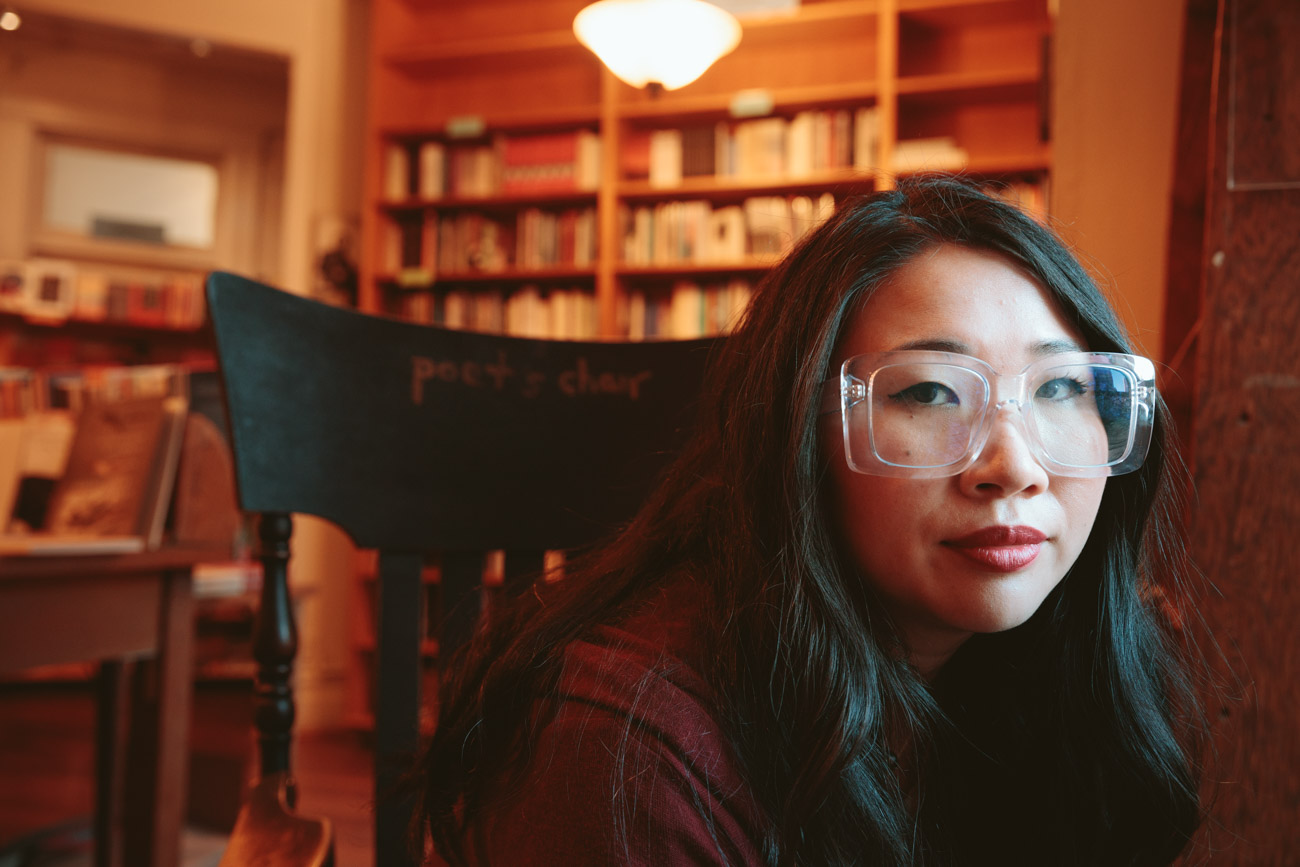
Alan Chazaro is the author of These Spaceships Weren’t Built For Us (Tia Chucha Press, 2026), Notes from the Eastern Span of the Bay Bridge (Ghost City Press, 2021), Piñata Theory (Black Lawrence Press, 2020), and This Is Not a Frank Ocean Cover Album (Black Lawrence Press, 2019). He is a graduate of June Jordan’s Poetry for the People program at UC Berkeley and was selected as a Lawrence Ferlinghetti Poetry Fellow at the University of San Francisco. His work can be found in NPR, The Guardian, SLAM, GQ, L.A. Times, and more. He is currently based in Veracruz.
Introduction:
These Spaceships Weren’t Built for Us is grounded in Chazaro’s upbringing. Even when they travel geographically, temporally, galactically, these poems are filled with tenderness for the poet’s beloved Bay Area, the rappers and hip hop artists who have influenced him, and his Mexican American and broader first-generation immigrant community who “all shared this soundtrack: pochos, Chinitos, Filipinos— / immigrant families near the Bay’s shoreline.” These poems are political—how can they not be?—but love is their beating heart.
Unlike Chazaro’s previous collections, Spaceships lifts off far beyond this burning Earth. Organized into three sections titled “here,” “there,” and “gone,” the poems in Spaceships reimagine the future through the lens of space travel, science fiction, and unrealized possibilities. These Spaceships Weren’t Built for Us, Chazaro states upfront, so we must build our own. When we do, perhaps we can manifest a world in which “paleteros will be / the most luminous gods we’ve known.”
Jenny Qi: You’ve mentioned that you feel like this book is your most “experimental” because of the sci-fi elements, which is something that stands out to me as well. There’s a real Chicanafuturist energy to this book. What influenced this shift in your work?
Alan Chazaro: A lot of my writing goes back to my roots. My first real introduction to [poetry] was as a young person enrolled in UC Berkeley’s Poetry for the People program in 2007. The program was founded by June Jordan and for decades has been a community-centered space on campus where students and actual residents of the city can take poetry workshops together. The program is focused on the tenet that poetry is a basic expression of the self, and we shouldn’t shy away from directly telling our stories. That gave me the confidence to lean into my background early on as a Bay Area-raised Mexican American kid who grew up avoiding my academic responsibilities and doing graffiti as a teenager. I never felt like someone who was allowed to write or appreciate poetry, until P4P taught me that those experiences are equally valid.
When I started this book, I was a full-time high school teacher at the Oakland School for the Arts, surrounded by young, brilliant, fearlessly creative teenagers. I would share my ideas about outer space and poetry, and some of them would riff on it with me . . . That resulted in me wanting to try writing something unexpected for myself, while still being grounded in my identity: poems about space, about immigration, about displacement, about alternate universes, and everything that it could encompass for future readers.
JQ: I love that. You’ve been quite prolific, publishing two chapbooks and two full-length collections in seven years. How do you feel you’ve evolved or what have you learned over the course of creating this initial body of work?
AC: I came into poetry at a pivotal age as a young man living in a male-centric environment . . . looking for an outlet. In 2015, I took a temporary break from teaching full-time and attended the University of San Francisco’s MFA program, where I wrote the majority of my first full-length book and my first chapbook. Maybe my biggest lesson has been that poems and poets don’t always have to know what they’re about. I now enter a poem with questions, and don’t really care if I land on answers. In doing that, I’ll sometimes stumble into a moment of unexpected revelation.
JQ: One of my favorite poems in Spaceships is “Someone’s Astronaut Tío Is Selling a Constellation of Paletas on a Faraway Tropical Planet.” It’s so tender and specific, and yet as a non-Mexican American first-gen (1.5-gen?) kid, I still relate. These paleteros are often on the periphery of society, but they are also each “someone else’s tío.” Can you tell me about the inspiration behind the poem and the process of writing it?
AC: Some of my earliest memories growing up in California, and also visiting Mexico, was seeing hella paleteros everywhere. In my neighborhood, there were always older immigrant men wheeling their carts around. As a kid, that evokes a certain kind of joy and excitement. Just pure, good vibes. Once you get older, you start to understand the social and economic layers, and the paleteros become a symbol of not merely joy, but of cultural preservation, of diaspora, of inequality, of perseverance. I remember one of the paleteros in my area got robbed at knifepoint once, and I could only think to myself about who could ever do that to such a humble, hardworking person. There’s a kind of vulnerability, if not invisibility, for many paleteros, who roam the streets, carrying cash, and are sometimes undocumented. In an ideal world, they would be welcomed and praised, not assaulted or targeted. That sparked my idea for a poem in this collection, which is largely sci-fi-inspired already, about paleteros who are revered as deities because they serve paletas on a hot, tropical planet in some other galaxy. They are not peripheral. Instead, they are the ones who provide a sort of salvation in that imaginary world.
JQ: That’s lovely. Spaceships is divided into three sections, titled “here,” “there,” and “gone.” I’d love to hear about how you decided on this organizational structure for the book.
AC: I like to frequently revisit each individual poem to see how they are in conversation with one another, how they push and pull and build tension and friction. In thinking about space travel, and traveling across physical space, it felt natural for me to outline things in my mind as destinations, kind of like markers on a map. This is where we’ve been, there is where we’re going, and this is us having left. It helped me to have a sense of those different phases of travel and movement.
JQ: While “here” and “there” are sort of an obvious pairing, it’s interesting to me that you decided to name the last section “gone.”
AC: I definitely wanted the book to have some kind of future-leaning perspective. It’s not just about where we’ve been and what we know, but also about what could be. I wrote this book while I was in an extended process of leaving the United States. In 2019, my wife and I both decided to leave our jobs as full-time high school teachers in California to travel and live for an extended period in Latin America. Going from working full-time in the Bay Area—the global epicenter of tech and exorbitant wealth—to freely traveling around South America and Mexico, was a privilege and a spiritual and mental reset. Being able to do that in a way where we can see family and friends, too—some who have been deported, and others who simply wanted to leave the U.S. on their own terms—has been a major component of my own grappling with what it means to be a dual citizen of the U.S. and Mexico, and to remain living in the north by choice. So that feeling of wanting to leave, and then actually being “gone” was a real thing for me.
JQ: In some ways, this book doesn’t feel too different from your previous work. One of the common threads that I appreciate is the extensive intertextuality. We’re all heavily influenced by other creators, but your influences are right there on the page, in constant conversation. You reference rappers and hip hop artists in several poems (and even the title of your first chapbook), and the titles of your poems often resemble song titles. Could you talk about what music means to you and its influence on your poetry?
AC: Ah, dude, hip-hop and rap—and just music in general, including punk, classic rock, and heavy metal—have been my lifeline. I grew up in a home without much structure or guidance. My dad was and is an amazing guy. But he’s never been the type of parent who will put on a record from his days and tell me to sit back and soak it in. He worked, he was single, he took us to play sports. But he never once, in my memory, shared music with me or my older brother. When I was in elementary school, I remember hearing E-40 for the first time on the radio. Also Tupac, Ice Cube, Snoop—all of the West Coast legends. I have a vivid memory of being in our neighbor’s apartment and using his older brother’s stereo to listen to the local hip-hop radio station. E-40’s “Sprinkle Me” was a hit song. I can’t explain it, but that sound and style has never left me. I think because I didn’t have any musical traditions or lineages passed down to me from my parents, hip-hop, Bay Area hip-hop especially, felt like one of the first things in my life that was mine. When it comes to lyricism, poetics, funk, all of that, nothing has ever been able to top rap for me. It’s storytelling. It’s world building. It’s representing where you’re from and what you’re about. It’s hypnotic and rhythmic. It’s communal. It’s everything I hope my poetry can embody and preserve. One of the poems in this book [“No One Has Ever Told Me To Go Back to My Planet, But If They Did, I’d Roll Up My Space Hoopty’s Windows and Listen to ‘M.E.T.H.O.D. Man’”] is a very direct tribute to that.
JQ: Yeah, I feel that! Another poem that struck me was “An Introduction to American Pathology (Remix).” It’s so rich with pop culture references, from Baby Keem to the X-Men, but they don’t necessarily represent the speaker’s culture of descent, as he points out in the parenthetical “(none are Latino).” (Very relatable as a first-gen millennial.) A line that I keep coming back to is the beginning of the sixth stanza: “Isn’t naming something a type of self-love?” Can you say more? What does self-love mean to you, living in this body in this place and time?
AC: I think when you feel like you come from a place where not much is given, you learn not to take things for granted. Something as simple as naming, or self-labeling, can become a powerful declaration, a reclamation. I’ve found that my happiest moments and journeys begin with that simple act of naming something: this is what I want, this is who I want to be, this is what I am. More than ever, we live in a society of distractions, of open hate, of misinformation and sensory overload. I think it’s necessary to have a grounded sense of self. You can’t half-step with it.
JQ: There are three poems in this book about “Pocho Boy,” where the title is in the third person, but the poem itself is not. Can you tell me about the Pocho Boy persona and why you chose to structure these poems in this way?
AC: I developed personas as a way to tap into some semi-fictional creativity with my poems. I wrote a series of poems that featured “Neon Boy,” and I also adopted “Pocho Boy.” Going back to my hip-hop inspirations, it’s kind of an ode to something like Kendrick Lamar’s breakout album, good kid, m.A.A.d city, in which he narrates a summer in Los Angeles through the lens of a good kid navigating a wild, unforgiving environment. It’s all in the first person, but it’s also kind of framed as a general character in the title. It’s also like a comic book character’s alter ego. Pocho Boy is actually still my Twitter handle (R.I.P.), and I published in 2019 when I initially left the U.S., all under that moniker. For those who don’t know, “pocho” is a historically derogatory term used by Mexicans to describe Mexican Americans who are disconnected from Mexico and speak broken Spanish. Pocho is like a synonym for “not enough” or “incomplete” when it comes to one’s Mexicanness. But Sara Borjas, a Fresno poet who is now based in Oakland, and who published one of my favorite books in the past decade, Heart Like a Window, Mouth Like a Cliff, reclaimed the term and reinvented it for herself, which empowered me to do the same.
JQ: In my initial reading of Spaceships, I thought “Song of Revival in New York City While My Father Is Asleep” was going to be the last poem, ending powerfully on “I am still here, holding on.” But then I turned the page, to the actual final poem, “At the End of the World, All the Homies Pull Up to an Abandoned Gas Station in Alameda to Watch the Last Corpse Flower Bloom,” which ends, “let’s remain / here: encircling ourselves, together and whole.” It feels really meaningful to me that this book should end back in the Bay, with the collective rather than the individual, so I’m wondering if that was a conscious decision you made?
AC: Such a dope observation. I didn’t consciously or strategically plan it that way, but it totally makes sense for what this book was largely grappling with, which is finding a way to stay grounded in a home, or in a world that seems to be getting further and further out of reach. In many ways, I feel like I got pushed out of the Bay as a local. Raising my family on the cocktail salary of a poet, journalist, and professor just isn’t feasible in the Bay anymore, so I had to grapple with that and build my own spaceship to find a more welcoming soil. But my desire to be home, in my community, hasn’t gone away, so it makes sense that my spirit still very much feels like it’s back at some gas station in Alameda with everyone who has been a part of my evolution as a Bay Area person. That won’t ever change no matter how far away I move.
JQ: Yeah, your work feels so rooted in the Bay, even though you’re no longer based there. How has that transition been for you? What does it mean to you to be from a place or to claim belonging in this way? (I ask as I grapple with these questions myself.)
AC: It’s a neverending process for me. It’s an odd thing to be Mexican American. It can be an intense identity rift: to grow up in California, which was formerly Mexico, as the child of Mexican immigrants, while also traveling back to Mexico frequently as a kid, and having to make sense of all that. I can’t think of another group of people who have to live on the literal and metaphorical borders of their identity as closely, and as under so much scrutiny and comparison, as Mexican Americans. The literal proximity of it is wild. As a documented person, I can hop in my car right now and drive home if I wanted to, on either side of the border. Most immigrants or diasporic folks around the world don’t have that kind of access to be in such a strong, direct connection to the places that their parents or grandparents are from. It’s the whole “we’re not from here, and we’re not from there” thing, too. But it’s also its own kind of third culture, apart from anything else. And it gets even more complicated by region, because Bay Area Chicanos aren’t really the same as L.A. or San Antonio Chicanos. Each has their own idiosyncrasies, ties to Mexico, understanding of American values, foods, sources of collective pride. So I’ve found that the most accurate way of triangulating who I am is to tell people that I’m from the Bay Area—not the United States, not Mexico. As the inimitable Mac Dre once said, “In the Bay Area, we dance a little different.” And I take that everywhere I go.
JQ: You were with Black Lawrence Press for your first chapbook and full-length, having won contests for both, and since then, you’ve worked with two new publishers. What have you learned about the publication process through working with all of them? How was the experience of publishing through winning a contest different?
AC: I love each that I’ve worked with—Black Lawrence, Ghost City, and now Tia Chucha. They all have been caring and supportive in their own ways. Black Lawrence was unique because I submitted my first chapbook, and my first full-length, at the same time, and they both ended up winning separate contests back-to-back. When the press founder, Diane Goettel, called to tell me the news, she said that had never happened before, but they were all-in on my work and gave me the opportunity, as a relatively unknown and emerging voice, to have a platform.
The next books can become trickier, in a way, if you’re doing things independently. I gravitate towards presses and people who I feel like are putting out good, genuine work that feels grounded in community values. Ghost City has always been a very small press that I’ve respected, so I was happy when they accepted one of my chapbooks. Tia Chucha is a full-circle dream for me, since their founder, Luis J. Rodriguez, is one of the first writers I ever wanted to emulate when I read his books as a teenager in community college. It’s also cool that Spaceships is the first title in a new partnership between Tia Chucha, the Letras Latinas program at the University of Notre Dame’s Institute for Latino Studies, and Red Hen Press. With each experience, I get to see how presses operate across a spectrum, and how they’re structured, funded, and staffed.
JQ: What’s next for you?
AC: I have been sitting on another set of poems that are focused on the nuances of violence, corruption, and machismo in Mexico. They were inspired by living and traveling all over Mexico and include roadtrips, bullfights, drinking with politicians, unpacking myths about the chupacabra, and other influences that define what it means for me to exist in the parts of Mexico that aren’t the glamorous beach resorts or touristic getaways. It has a darker energy in some ways, but, as always, I’m hoping that it illuminates the rich, complex intertanglings of how I am able to engage with Mexico as a wandering observer. I always want to be mindful and intentional about how I portray a place or an experience, so I still have a lot of work to do on that front—but in terms of poetry, I want that to be my next offering, even if it takes me another decade to finish. Check back with me in ten years.