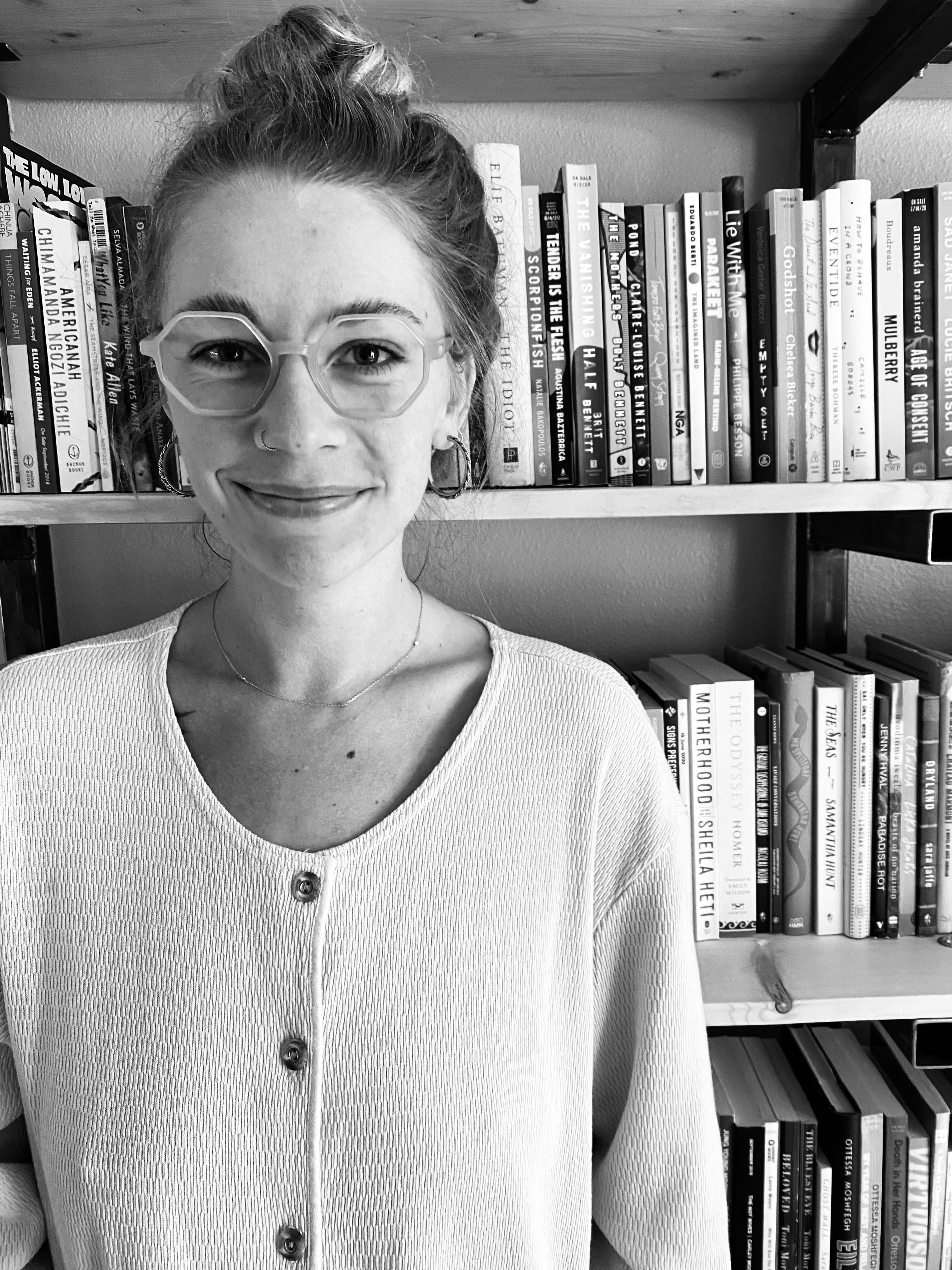
CMarie Fuhrman is the author of Salmon Weather: Writing from the Land of No Return and Camped Beneath the Dam: Poems and the co-editor of Cascadia Field Guide: Art, Ecology, and Poetry and Native Voices: Indigenous Poetry, Craft, and Conversations. She has published poetry and nonfiction in numerous magazines, including Terrain.org, Emergence Magazine, The Ex-Puritan, Northwest Review, Yellow Medicine Review, Poetry Northwest, and various anthologies. CMarie is an award-winning columnist for the Inlander and the Director of the Elk River Writers Workshop. CMarie is the Associate Director of the Graduate Program in Creative Writing at Western Colorado University, where she teaches poetry and nature writing. CMarie is the host of Colorado Public Radio’s Terra Firma podcast. She is a former Idaho Writer in Residence and lives in the Salmon River Mountains of Idaho. CMarieFuhrman.com
–
CMarie Fuhrman and I earned our MFAs from the same program, at the University of Idaho, though not at the same time. She left just a year or two before I arrived, and her name still floated around the grain silos and the big tree we all sat under when we had poetry workshop outside. Respect gathered around it.
It’s an understatement to say that I’ve been looking forward to this poet’s debut collection of prose for a long time. I read and reread CMarie’s essay “Lake 8” in Platform Review, on counting fish in alpine lakes and relating to wilderness in an aging woman’s body, for years. I wondered what timbre this grounded voice would inhabit when stretched to book length.
And the answer is something more intriguing than I could’ve known. Here is a wild rural voice living into her environment not as a human on top of the land but as a woman in the belly of it. As much about hunting as about salmon runs, the pieces that make up this book layer wonder and violence together like they’re skin on the same body. CMarie uses commas endlessly, laying things side by side without preferencing, and always coming on strong but in feminine and humble and sometimes self-contradictory ways. Salmon Weather is shot through with a poet’s sensibility and marked by a patient and disciplined plodding on that’s interrupted, in moments, by flares of its opposite. It’s so very human, and it was a pleasure to talk about it.
–
Afton Montgomery: Let’s begin with naming. Sometimes, in this book, you eschew it: “Let’s not name this drainage we walk, nor this creek.” Sometimes you help a reader build a place with our bodies instead of giving it language. “To know the South Fork of the Salmon River, raise your hands… and lace your fingers together until right knuckles meet left. Here, the river winds through.” Some things you name clearly: Salmon, Flicker, Coyote, Wilderness. In other moments, you worry over the impossibility of getting a name right, writing of Hells Canyon, “I think of how I might rename it and falter, tripped by my need to tell everything I know about the canyon in a couple of words.”
To describe your own writing, you call Salmon Weather a “stack of stories.” It’s an unconventional name for a collection of nonfiction. What does the word story mean to you? What power is there in giving true writings this name?
CMarie Fuhrman: This is a fantastic question. Thank you for giving me the chance to think about it.
What this question makes me think of is something that may be a bigger complication in our culture right now, this need to categorize and to label, to make something one thing or another. That is not to say that there is not a need for names or even, at times for categories, sections where you know that what you are looking for you will find, but when it comes to art, at least my own writing, I can’t talk about, let alone think about my prose as, frankly, prose. So much of my writing is influenced by the craft of poetry and so there is that. I suppose I could call them lyrical essays, but I struggle, too, with the word essay, as that is also not what these are.
When in community, when recounting an event, we often call it a story. For me, to say, “I’d like to tell you a story,” feels much more intimate, and indeed what I am doing than, “I’d like to read you an essay.” The word story opens up so much more. And might that be confused with fiction? I guess that is a risk I’ll take, but I caution against assuming story as fiction because I feel like that assumption continues to marginalize and further discriminate against communities and writers who have used story as science, as knowledge, as a way of passing down history, or even of our creation—as truth telling. So calling the offerings in Salmon Weather stories, to me, is a way of both freeing the writer and writing, and changing the expectation of the reader and the genre.
AM: In the essay “Coyote Story,” the speaker finds and then shoots a coyote whose leg is caught in the silver teeth of a trap. The necessity of this mercy is immediate to her. But she struggles to follow through, trying first up close with the handgun she has in her car and then driving home for a rifle. The coyote looks too much like her dog, Katie. She requires distance to take its life.
It seems that this speaker is often trying to get the right critical distance—a better vantage—a sense of which parts of her are responsible and for what. She struggles to reconcile her parts. You write in the essay, “Being human in the West… is a threat, no matter how kindly and carefully I walk,” while reckoning with being part Indigenous and part European colonizer. “I am two people,” you warn the animals of the forest in summer: hiker and hunter. “I am not to be trusted.” Ultimately, in this moment that bowled me over, you say, “I keep coming back to the coyote story because I shot the coyote. Twice.”
It’s the twice. We only learn later that the far-off rifle shot was poor and that you had to walk back to the stunned coyote and take a second shot up close, with the pistol. Both parts of this speaker enacted mercy and both parts violence.
Will you tell me about crafting duality in this story? And about its collapse or complication or resolution, whatever you might call this moment when we learn that there were two shots? What bearing (if any) does that have on the essay’s questions about heritage and responsibility?
CMF: Much of the reckoning that is happening within “Coyote Story” and throughout the book is again with the expectation that we are one or the other. This duality not only exists with humans, again those labels attached—case good/evil, right/wrong, colonized/colonizer—but very palpably in the west, in “Lake 8” for example, when a lake is labeled barren because it is non-fish producing and thus not as valuable to some people and some agencies. What happens to us when we only allow ourselves two categories? When there are only black hats and white hats, tree huggers and tree cutters? Well, I think we are seeing exactly what happens. Our culture is divided and unaccepting of anything or anyone that falls into this “and” area. There is a refusal that two or more things can be true at the same time, and that refusal is dividing us not only as a nation, but within ourselves. Complexity could be our strength, but like the nucleus of an atom that is forced to divide, the result is catastrophic.
I am constantly interested in that space where all things are true because the energy and label is stripped. As a mixed-race human, I am not going to deny the colonizer for the colonized. As a hunter, I still absolutely love the animals I hunt and I am not about to deny that. I also mourn for and simultaneously love burned land and fire. I am ok living in the complicated and complex and I want these stories to live in those places as well.
That second shot, I think, released both Coyote and myself from the trap of identity, of being one or the other, of the trap set by someone who saw Coyote as varmint and destroyed by someone who sees her as kin.
AM: Late in Salmon Weather, you give us an essay written entirely in second person; “No Way to Say Goodbye” is addressed to your partner Caleb. The reader knows from the beginning that your first husband Randy drowned in a river accident many years before this moment, and that now Caleb is setting out to float the Selway River. But most of this essay exists in its narrator’s speculative imagination—her awake nightmare as she imagines Caleb drowning as Randy did. Tell me about your use of the second person and of the speculative to translate a very specific sort of fear to a reader.
CMF: I didn’t think about this story. I pulled over after dropping Caleb and his friends off and wrote it. All of the anger and fear and love I had for both Randy and Caleb (and myself) poured it. That it took the form it did was all the story’s doing.
Later, when I returned to “No Way to Say Goodbye,” I did think about such an extended use of second person. Was it working for the story? Because it does read like a letter and because intimacy matters so greatly to me in this piece (the need to have the reader very close, to have the reader feel some amount of complicity) I kept it in second person. How else could I possibly help the reader who has lost someone in the way I had, or is an adventurer the way Caleb is, or who has no connection to either, understand what I feel like in those moments when I am reliving the most tragic event in my life. For this story, there was no other way than the direct address.
And for me, there was no other way to express my own anger and love than to address both men. Anything else would have set me too far apart from the emotion and the urgency, and the reader, I believe, would have felt that.
AM: In one essay, you write about failing to write a poem. “Rather than giving the image control, in this case, the river’s image, I try to control it.” Of course, this whole book battles the same urge. We know from page two that the voice guiding us through these pages lost her first husband to a river when she was only thirty-two. Every essay draws our attention to water sloughing off the silt of hillsides and carrying minerals downhill, downstream. We know we are meeting a woman who has every reason to resent water’s downward pull because of what The Clark’s Fork in Wyoming took from her when it took Randy’s life. But the magic of this book, and the reason it works in the way the poem wasn’t working, is that it isn’t guided by her definitional feeling about the river, it’s guided by the river itself. And the river brings to her over and over as much as it’s taken away.
In what ways did landscape teach you how to write these stories and how to write them well?
CMF: This is a wonderful question, Afton!
I feel there are as many ways to answer this question as there are ways that I have learned from the land. But I also want to be careful here because the answer could easily slip into pragmatism and an expectation that the land either owes us this teaching or has a single lesson, neither of which are true.
But I think in the case of rivers, and for myself, I backed away from traditional symbolism, which can sometimes get in the way of actual relationship, and never used the river merely to inform the story, or carry symbolism, but to be character. To have agency in the writing and with that agency carry the river’s own meaning. I suppose that what I am trying to say is that the landscape doesn’t so much teach me, though I have learned much about the land and rivers from time spent together, as it does carry equal weight and resonance and importance to any human presence in the story—and sometimes more. In the end, the story is, of course, from my point of view and my own bias, but as much as I can I want to witness and translate or interpret what I see and experience. I want to offer that to the reader in hopes they find their own meaning.
This reminds me of a question I am often asked, “When did you first discover your affinity for nature?” I still can’t answer this because I don’t think there was a first moment. As a baby, my parents took me camping, and as a young girl, I would leave my bed to go outside and sleep in the lawn under the stars until, eventually, my mom and dad moved my bed out onto the porch. I have never felt separate from nature, not at odds with her, nor as if I am owed anything. Ours is a relationship built on simply being made of the same stuff, which I suppose we all have. And even as I cannot suss out the myriad ways that nature has informed my stories and the way that I write, I know that much is owed in our relationship to the voice that exists in my writing.
In the end, I suppose my resistance is also some amount of resistance toward any dogma about writing or how to write the nonhuman. Those rules come from an overculture that continually seeks ways to contain and colonize. I am not denying the aspects of myself and writing that have been influenced by that culture, I am acknowledging that I am aware of them and where I can, working against them.
AM: You dedicated this book to Kim Barnes, who is well known in circles around the University of Idaho MFA program for her “knife prompt,” which involved, as I understand it, workshop participants passing around Kim’s switchblade and letting it conjure personal knife stories that they’d tell aloud. In reading Salmon Weather, I wondered if the essay “Aspen” came from this.
Will you share your experience of Kim’s prompt and talk me through translating a somatic experience (like holding a knife) into the language experience that is an essay or story?
CMF: I am delighted that you recognized that “Aspen” came from Kim’s prompt—indeed it did! I was first going to write about my mother’s paring knife, and someday I may still do that, but I was still seeking ways to heal from Randy’s death and this was a step in that direction.
It’s funny, but I didn’t remember Kim passing the knife around until you mentioned it. And when I think about it now, when I see myself in that room where we met for class, I don’t imagine her knife in my hand, but the one in the story. The one I still own.
I can feel its weight in my hand and the weight of responsibility that it carried when my father handed it to me one summer. There is a story there, certainly, too. My father handing me a knife as a coming of age, then Kim, then, after I graduated, Caleb gifted me with a new knife, specially made with an Aspen handle and an inscription on the blade. Kim would hint towards an image hoard here, a symbol or item that keeps returning, like the rivers, that will no doubt continue to come up in my writing.
I am a very sentimental person. The items I keep from my first teddy bear to the knife to my mother’s coin purse from the early 70s are all imbued with meaning. So to an outside observer, they are just things, an old knife, a ratty teddy bear, and a purse whose gilt rubbed off to show that it was a cheap pretty thing. But when I see those items, I see the worlds they hold. I feel the weight or lightness physically. I feel their memories in my body at all the ages I ever was. It matters to me that I keep coins in that purse of my mom’s. That I can still hear the click it makes when I put special coins in it, and that echo is her opening it with that same click and handing me a quarter to ride the pony at Kmart.
That sentimentality extends beyond the things in our home. And maybe here is the place where we separate from the word “sentimental” and complicate it with the words “relationship” and “nostalgia,” all of which have been frowned at one time or another by those who might claim to know what good writing is. Jim Harrison writes, the writer “who refuses sentiment refuses the full spectrum of human behavior, and then he just dries up. . . . I would rather give full vent to all human loves and disappointments, and take a chance on being corny, than die a smartass.” I’ll take that chance, too, because I share the same feelings about things as I do about places. I visit trees. There are bends in the river that I become nostalgic for, even a time, ecologically that I never experienced but only visited in photos.
When thinking about leaving McCall, which someday we may have to do, both Caleb and I agree that we would miss certain places, for their beauty and wildness, sure, but also for our stories. There are creeks we visit and talk about our dog Carhartt and how she lay in them, the granite cold water lifting her fur. The place where our Cisco dog took his last hike, and where Apache, our newest dog. was chased by Raven. There is a place on the South Fork of the Salmon River where Caleb and I stood in a crowd of Balsamroot Arrowleaf in bloom, as if we had found where sunrises were born, and cried. We revisit those places, we retell their stories when we go there. We visit bones and arrowheads.
I have a relationship with the land that carries all the emotion of any human relationship, including and especially sentimentality and nostalgia. My stories will never shy away from that and never should, because emotion is the somatic experience, is the register in my body that was the heaviness of the knife, the joy of the bright yellow flowers, the longing for a dog whose bones are in the soil. I cannot write a story if I cannot feel it in my body. At least for me, there are few times that I separate body from mind; the somatic experience cannot be teased out from the bodiless.
Referring back to the question about how landscape informs writing, I want to give a nod to Kim and why I dedicated the book to her. She never forced my writing into some container of what it “should” be. Instead, just as I let the story or poem try to inform me about what and who it wants to be, so Kim did and still does for me.
–