My first love in college was not a boy, but a book: Anne Carson’s The Beauty of the Husband. One early autumn weekend, I lay in a warm patch of grass, outside my dormitory, the leaves just beginning to turn. I would pick up the book in a rapture, read a poem or two, and then rest the book on my chest, savoring the clarity of thought: “All myth is an enriched pattern,/ a two-faced proposition,/ allowing its operator to say one thing and mean another, to lead a double/ life./ Hence the notion found early in ancient thought that all poets are liars./ And from the true lies of poetry/ trickled out a question.// What really connects words and things?”
In workshops, my classmates and I often defaulted to questioning the reality of each other’s writing as criticism: “Does this image feel real?” “Does this speaker seem real to you?” This led to a low grade, constant monitoring of my imagination before the blank page. How would I write an Indian speaker? Should I write about dahl? Or conversely, should I never? And what if I was more interested in describing what went on under the surface, rage or longing, that was both unique to the speaker and yet inexorably linked to an emotional inheritance? How could I bring in food, or landscape, if the poem called for it? Was the connection between words and things a straight line, or should it be more opaque?
Keats famously wrote that a great thinker should be “capable of being in uncertainties, mysteries, doubts, without any irritable reaching after fact and reason,” naming this prized quality negative capability. But in college, when I would think, I inevitably reached after reason. I was looking for the certainty of a mirror. When I would read, I wanted to find something real inside the book’s pages, my understanding of reality reflected back to me.
In adolescence, I combed books and movies for any sound remotely resembling an Indian name, or any shade of skin darker than tan. I wanted art to be a literal mirror because my physical existence confused me. My parents had immigrated to Raleigh from Bombay. Each Thanksgiving, we ate curry. And when I was ten, this tormented me. Back then, I had no conception of “diaspora,” only my mother’s stories, which existed in my imagination worlds apart from the stories I ingested at the library. As a child and teen, I would wonder, distraught, do I exist if I can’t see myself in art?
Of course, the answer was: if I could not see my reflection, I would have to make my own mirror. During the summer between 11th and 12th grade, I won a scholarship to a summer program where I studied theatre and philosophy. As part of our vocal warmups, our teachers had us lay on the black box floor, and recite the preface to Oscar Wilde’s The Picture of Dorian Gray. Running through my mind in late teenagerhood were Wilde’s ominous lines: “All art is at once surface and symbol. Those who go beneath the surface do so at their peril. Those who read the symbol do so at their peril.”
I believed in the perils of artmaking, of trying to convey reality and getting it wrong, of creating a cheap illusion. These fears, where did they come from?
When I was younger, my parents seldom spoke of the past. Why leave a place only to invoke it through language? And yet, we do this through reading all the time. Last winter, I was reading Mrs. Dalloway. Outside, the world was brisk and cold. But each time I opened the novel, on the subway, at a coffee shop, it was a sunny, London June. So, there it was, June amid my winter. Which one of these months was more real?
“It is only with the heart that one can see rightly. What is essential is invisible to the eye,” says the fox to the Little Prince. Can the clarity of our feelings be a kind of “seeing,” as they are also a mode of perception? Is it possible that the eye sometimes confuses us with the surface of things, when what we are grasping at is hidden—an interior experience?
Lately, I’ve been studying tarot, pulling one card each day, to see how the card might reveal the day, and how the day will later reveal the card. The tarot is rich with archetypes and symbolic imagery. Like revising a poem, a tarot reading is a densely populated system of images which we shuffle and reshuffle, and in doing so allow chance, or perhaps a higher consciousness, to come in. As we gaze upon the cards that chance, and our own hands, have dealt, we can recognize something of our own inner selves. The cards, like poetry, are a mirror.
When I gaze at the card in my palm, I try to blot out all preconceived stories, and instead try to see, with a new day’s eyes, the image before me. This morning, I drew the lovers. In my deck, Eve and Adam-like figures stand rooted in the earth, and above them an angel opening her arms. First, it is learned knowledge that comes to my mind—the feminine archetype is the passive recipient of wisdom, which is beautiful, but nothing without the masculine archetype of action. Yet, action is meaningless, or brute, without wisdom. I know the card speaks about movement toward union, a merging, a balancing, of energies.
I try to push my learned thoughts aside. What do I see in the image before me? Today, I am crossing Prospect Park under a late, summer sun. The heat wave that has been plaguing us has broken. Before me, a meadow, mostly empty, save for a few picnic blankets, dogs and their owners slowly making their way through the grass. Above us, the clouds are voluminous. A cumulonimbus, I think, remembering my 2nd grade project on clouds, how that day when I drew and re-drew their shapes inside my blue booklet, it rained. Periwinkle blue.
A thought occurs to me, how the lovers, open handed, stand rooted on the earth, and yet they are eye-level with the clouds, flagged by the tops of fruiting, flowering trees on either side. Heaven and earth united through the body’s conduit. And since I have drawn it, and since my perception has guided me, what does all this say, about my relationship to identity, art, and certainty?
Today I feel afraid. My book is out in the world, and isn’t this what I always dreamed of? To walk into a bookstore and scan the shelves, and find myself reflected inside a mirror of my own making?
Wilde, again, “The Artist is the creator of beautiful things. To reveal art and conceal the artist is art’s aim.” But how is the artist concealed, exactly, if the art is self-reflexive? And if we want art that is true, shouldn’t art reveal the artist?
I wrote my book employing the lyric “I.” “I” moves throughout the world of the poems, with a mother and father, lovers and griefs, losses, joy. But is the “I,” me?
“Off Havana, the ocean is green this morning/ of my birth” writes Susan Mitchell in her gorgeous poem, “Havana Birth.” A little while later:
On a green sofa five dresses wait
to be fitted. The seamstress kneeling at Mother’s feet
has no idea I am about to be born. Mother
pats her stomach which is flat
as the lace mats on the dressmaker’s table. She thinks
I’m playing in my room. But as usual, she’s wrong.
I’m about to be born in a park in Havana.
Look how the green sea transforms into the sofa. A seamstress works at Mother’s feet, fitting dresses, which would make sense for the rapid shifts of pregnancy, until we discover that Mother’s stomach is “flat/ as the lace mats on the dressmaker’s table.” Mother thinks the speaker is playing in her room, “but as usual, she’s wrong.// I’m about to be born in a park in Havana.”
The speaker, then, has already been born. The birth the title refers to is not literal, but metaphoric. I am thinking of the many baptisms I have witnessed in church growing up, usually a child, but sometimes a teen or adult, clad in a white gown, and then dipped (or submerged) in a marble pool of water, emerging once more, now clean of original sin, born anew. Is this second birth of Mitchell’s or the baptized, real? Perhaps not in the literal sense, and yet, there is an emotional truth to it, one phase has ended, a second has begun.
When I look into my bathroom mirror, it is my own face reflected back to me. If I smile, I see a smile, if I frown, my “self” frowns back at me. I cannot transcend my state, trapped within the confines of reality as I perceive it. Maybe the mirror I so desperately sought in my youth was never quite what I needed. Maybe instead of a mirror, I needed a door.
Rebecca Solnit opens her collection A Field Guide to Getting Lost with a sweeping imperative: “Leave the door open for the unknown, the door into the dark. That’s where the most important things come from, where you yourself came from, and where you will go.” I recently re-read this essay in Alaska this past June, where the light never quite reached dark, but rather a blue twilight, where fog furled and unfurled itself across a low hanging moon. I left the windows open for those few hours of night, to watch the light change. Solnit writes:
The things we want are transformative, and we don’t know or only think we know what is on the other side of that transformation. Love, wisdom, grace, inspiration—how do you go about finding these things that are in some ways about extending the boundaries of the self into unknown territory, about becoming someone else?
One answer is metaphor itself. When I was baptized, I did not die, and I was not born again, and yet in photos, there I was—before and after. Dry and alert, then wet and crying, supposedly removed of the stain of sin. In the after photos, my parents look happy. This was the first of the sacraments I was to receive, each marking another progression on my journey, where I would not die, or be reborn, and yet, some inner transformation would have occurred.
The inner life, that’s what concerns me. Can I write something that feels true to my own experience? Can I create an experience in language that a reader will encounter, and feel deeply moved? Can I build not a mirror, but a door, which upon opening, moves the reader, and myself, closer, if only for a moment, if only within an imaginary space?
To write the poems in my first book, I had to let go of reality, though it swirled all about me. Instead, I had to embrace the holes, the starts and stops of memory, phone calls with my parents, photos, journal entries. I had to step through the door of emotion, into a world of symbols and dreams. There, finally, I had the tools I needed: figuration, language, feeling.
And who will meet me here in this land of my own making?
–
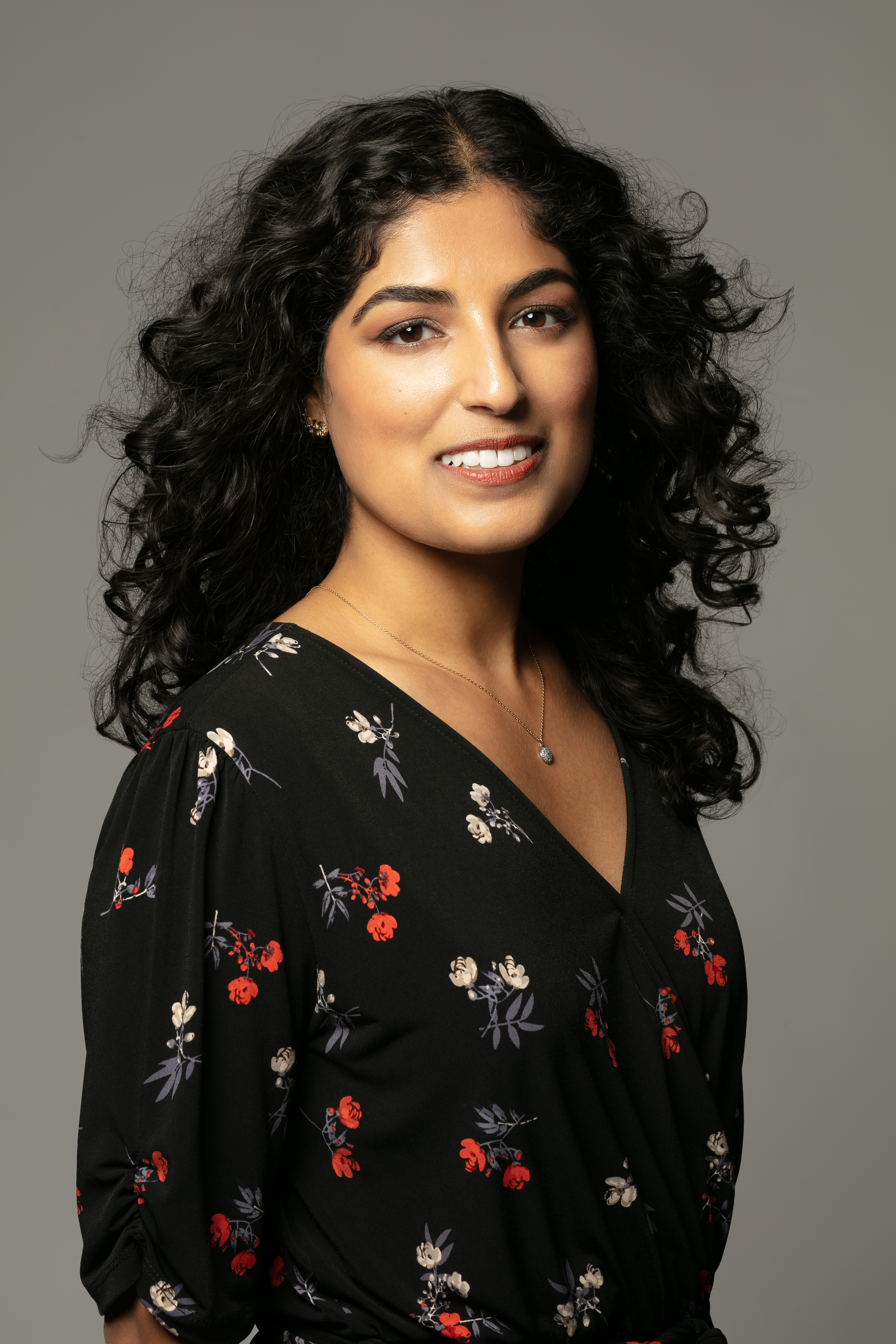
Megan Pinto is the author of Saints of Little Faith (Four Way Books, 2024). Her poems can be found in The Los Angeles Review of Books, Ploughshares, Lit Hub, and elsewhere. Megan lives and writes in Brooklyn. Find her online at www.meganpinto.com
Author photo by Beowulf Sheehan.