
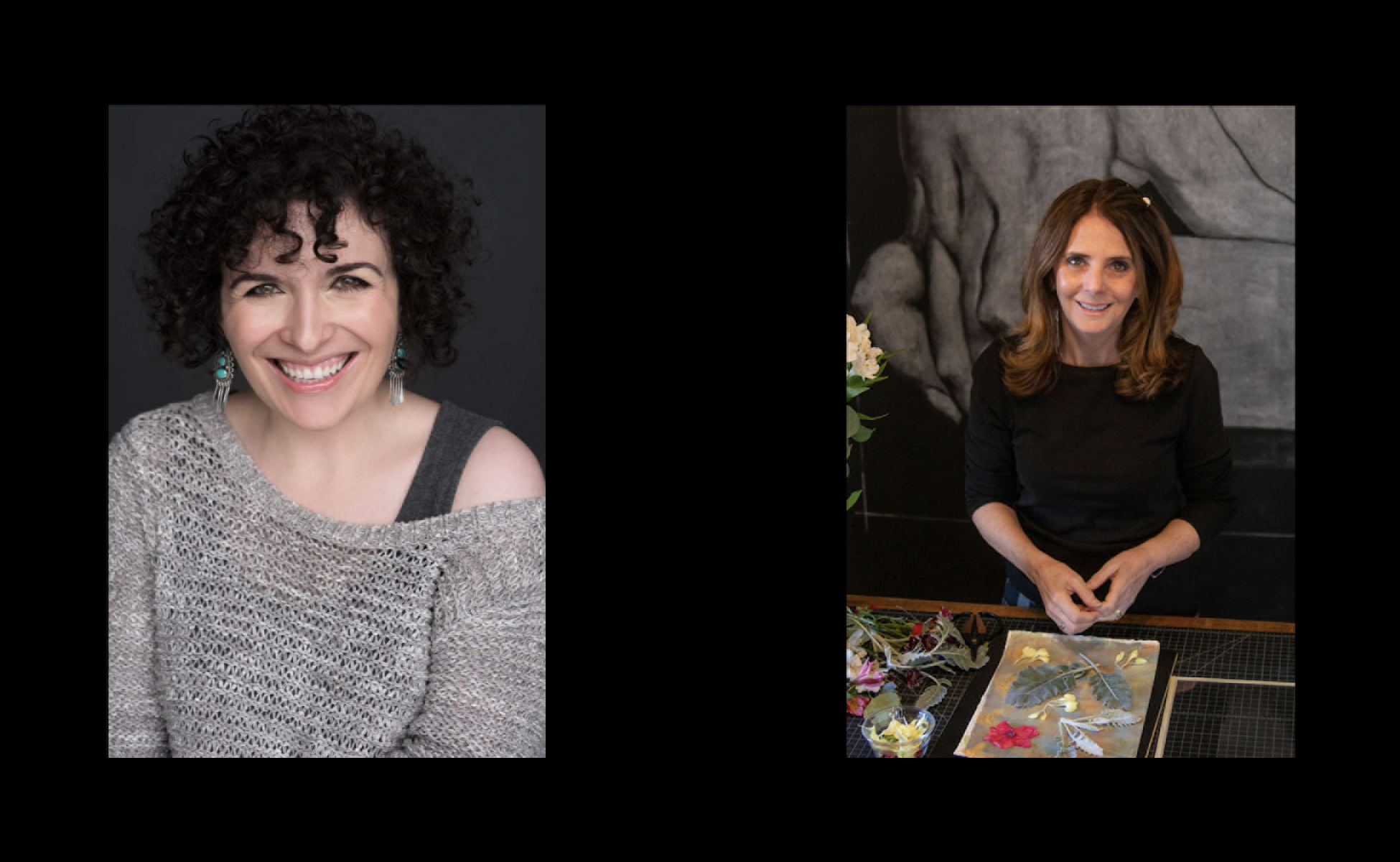
Jehanne Dubrow is the author of more than a dozen books including poetry and creative nonfiction. Her new book, Exhibitions: Essays on Art & Atrocity was released in September 2023 from University of New Mexico Press. More at jehannedubrow.com.
Beth Kephart is the author of more than three dozen books and a book artist. Her new book, in part a tribute to Dard Hunter, My Life in Paper: Adventures in Ephemera, is now available from Temple University Press. More at bethkephartbooks.com and bind-arts.com.
Jehanne Dubrow and I were introduced by Cassie Mannes Murray—a writer and publicist with an extreme talent for imagining possibilities and forging connections. I read Jehanne’s new book, Exhibitions: Essays on Art and Atrocity, in a day—overwhelmed by its power, intelligence, and formal ingenuity. I was eager to speak with her, to find out more about her transcendent relationship with literature and art. I was grateful for Jehanne’s reading of my own new book, My Life in Paper: Adventures in Ephemera, and for the conversation that ensued. It is our pleasure to share that with you. — Beth Kephart
***
Beth Kephart: You dedicate your book Exhibitions to your parents who, you say, taught you the “beauty and terror of looking at the world.” How do these two words emphasize or relieve your subtitle, “Essays on Art and Atrocity?”
Jehanne Dubrow: Oh, this is such a good connection. I guess I see these words as forming an analogy. Art is to the beautiful as atrocity is to the terrifying. But maybe there’s chiasmus here too, that is, art can terrify, and atrocity can have its own kind of unnerving beauty. Exhibitions struggles with what to do about the beautiful, that it may be amoral, seductive, appealing even once we see its underlying horror.
I’m in the process of writing a craft book, The Wounded Line: A Guide to Writing Poems About Trauma. In the section on ekphrasis, I say that when we assume a clinical distance, stepping back to study and describe a work of art, we inevitably step back to study ourselves as well. Ekphrastic writing is a way of gazing outward in order to gaze in. So, the beauty and terror of looking at the world also come to mean the beauty and terror of looking at the self.
And this makes me think of how My Life in Paper opens: with an epigraph that calls attention to the ubiquity of this familiar material, paper. “Being so obvious, it has long been invisible.” The book’s prelude immediately makes clear that we will be asked to reimagine paper, to appreciate its history, its art, and the personal connections we form with it. And in looking at paper, we will be asked to see ourselves as well. “Our lives with paper,” you say. “Our lives.” The prelude does such a wonderful job of introducing us to the book’s concerns that I can’t help wondering when in the drafting process did you write it? Did it come first? Last?
BK: What an entirely thoughtful question (though of course, I want to stop and dwell on your own words above—the idea of amoral beauty, the terror of looking at the self). Life erupted from a need I did not know I had, in the wake of discovering a man, Dard Hunter, about whom I had known nothing. Those lines you quote above were among the very first lines I wrote. I was struggling to define this paper obsession to myself—why paper matters so much, not just to me, but, I hope, to others. Interestingly, though, I found the epigraph toward the end, in my big pile of old books about paper making.
Exhibitions is organized into six galleries. How, for this book, did you define the word gallery?
JD: I knew I wanted Exhibitions to function as a sequence of spaces that a reader might walk through. I think this idea comes out of my training as a poet. After all, the word “stanza” means room in Italian. Poetry is such an embodied, physical artform, and it has really shaped my thinking in the essay. When we go to a museum and wander through the galleries, we feel how the separate spaces are linked. We feel ourselves guided by the curator’s vision. But, in an effective exhibit, there are also moments when we are allowed to pause between galleries, to breathe, and to think about what we’re seeing. I hope Exhibitions contain both kinds of experiences.
I was very struck by the structure of My Life in Paper. The book is divided into sections with titles like “Obsession,” “Possession,” and “Obsession,” each one an idea that speaks to the significance of paper in our lives. But then, within those sections, we have small essays that explore the materiality of paper; they have titles like “Ticket,” “Library Card,” and “Receipt.” How did you discover that the book needed this kind of push-pull between the abstract and the concrete?
BK: You give my rational mind far too much credit. I felt my way toward this structure, intuited the need for the essayistic and personal firmly rooted in history, philosophy, and shared cultural references. The letters to Dard Hunter erupted—I’ll use that word again, for this book felt like that; it happened to me, it happened through me—from a kind of lonesomeness, a deep desire to correspond with someone who would not just honor my own obsession with paper, but who had lived a life with which I wholly empathized. He had lost, and I have lost. He wanted to build a home, and I have tried desperately to build a home. He wanted to leave something lasting behind, and I have that churning instinct, too. So much.
You write in “Landscape with Basilica” that you were “poisoned into life”—a shocking and gorgeous compilation of three words. It’s clear that some bad cheese was involved. But how has the story told of your birth shaped your relationship to this world?
JD: I was raised to believe that the world is a very dangerous, threatening place. Between hearing my grandmother’s stories of Nazi Germany and my mother’s tale of being held hostage at knifepoint when she was in her early twenties, I was taught—implicitly, I don’t think my family meant to shape me in this way—that the world isn’t safe. Growing up overseas, in countries that were often on the brink of violence or radical transformation, I learned other lessons about the precarity of order, democracy, nation states. And, yet, there are also delicious cheeses to eat and exquisite perfumes to smell and all the other pleasures of the body. That’s where I find solace: in the delights of the senses.
Speaking of the senses, I’m drawn to how you explore paper as a site, not only for emotion but also for sensation. Early in the book, the persona calls herself “a woman increasingly obsessed with the weight, the sense, the rights of paper. How we carry it. How it carries us.” Yes, paper is tactile. But it’s also ephemeral. What techniques did you use to make paper feel so solid, evoking not only its texture but the sounds it can make, its scent?
BK: It’s interesting. Despite the fact that I have taught memoir for years and have written seven craft books about its making, I never approach my own work with strategies or tactics in mind. Like Lars Horn, I think of words as having texture and dimension. It’s as if I am holding the vowels and the consonants in my hands as I work. At the same time, it can feel as if the words are drifting by, like notes in a musical score. So I hear language dimensionally, and I experience paper dimensionally, and I don’t have any real choice, in the end, in terms of how I put words to paper, or paper into words. I hear, I see, I weigh, I empathize, I know, and the language (for better or worse) drifts in.
To approach trauma, you write, “the artist must engage in an act of translation.” When you write in the book of your marriage, you are, I think, writing a series of translations. Is this true? Do you see your own work as acts of translation?
JD: Absolutely. Because I grew up all over the world, the challenge of cultural and linguistic translation has always been central to my thinking. And, when I became a writer, I realized that one of my writerly obsessions was this act of translation. In my poems and essays, I often struggle with what it means to be split between two communities, how that shapes one’s language, one’s way of communicating with others. On a craft level, I’m also interested in how to translate large, abstract ideas—like beauty or genocide—into images, a language rich in sensory detail.
In terms of sensory detail, I was struck by how vividly you render scenes. I’m thinking of “Death Certificate,” for instance, where you describe—so efficiently and poignantly—the three children sitting “shoulders against shoulders” as they learn of their grandmother’s death, only the brother’s legs long enough so that his feet touch the floor. And, just as you so often do, this beautiful, immersive scene is followed by a meditation that includes research, a reference, in this case, to an essay by Kathryn Schulz. I love this shift. How do you know when an essay needs multiple modes, when it needs to shift between personal, lived experience and a more scholarly, detached voice?
BK: I have pursued, throughout my writing and teaching life, the idea of the universal. How to take a story that is so particular and move it into a realm that belongs to any reader who has time and interest. I want my work, no matter how personal it is, to reawaken memories for others. To raise questions. To engage the curious or satisfy the unsettled. It all lies, for me, in the art of juxtaposition—what private and particular things are rubbed up against the shared.
The art in your essays is both the art one might hang on a wall and the art, the snapshots that we bracket with our memories and words. Which kind of art exerts its greatest power over you when you are doing the work of a writer?
JD: Please, don’t make me choose! No, really, I find both equally provocative. I’m drawn to the intentional composition of the art that hangs on a wall as well as the secrets, questions, and inferences that we often find in a casual, family snapshot. Who took the photograph? What happened just before and just after the picture was snapped? Who stands outside the frame?
Speaking of which, paper functions as both art and artifact in your book. I can’t resist asking: Which iteration of paper exerts its greatest power over you when you are doing the work of a writer?
BK: I love this question, but I will have to split the difference. When I am working as a writer, I want, I need, I depend on the artifact. When I am working as a book artist, give me the pulp, the score, the tear.
Fragments constitute the whole in Exhibitions, and the book is a compilation of forms—personal essay, braided essay, ekphrastic essay, prose poem, poem fragments. Talk to me about the art of your juxtapositions. How do you think about fragment aggregations at both the micro and the macro level?
JD: I think it might have been wiser for me to write Exhibitions as a memoir with clearly delineated chapters. But, when I set out to write the book, my goal was to learn how to write essays that took time to tell their stories. I had just published throughsmoke: an essay in notes, a nonfiction book comprised of hundreds of tiny sections, each one like an essay in miniature, most no more than 250 words. Exhibitions was my effort to teach my poet brain how to work in longer forms. I wanted to practice writing scenes and dialogue, to test out craft elements that felt very far outside my training.
Fragmentation is such an essential technique when it comes to representing trauma. Trauma is not linear. It’s an experience of shards and shatterings. Because so much of Exhibitions deals with trauma, I felt that fragmentation would be crucial to the book’s work as a whole. The fragments are mimetic.
Exhibitions found its splintered shape through its content. I was writing mostly about war and genocide, the kinds of histories that shatter the psyche. I was writing about delicate works of art, fragile things that shouldn’t survive. So, it was inevitable that the content would lead me toward a form that favored brokenness.
I see fragments—or maybe I should call them scraps, torn pieces—as equally important to the voice of My Life in Paper. You make tremendous use of lists in this book. Inventories. Registers. Right from the opening pages (“Baby books. Scrapbooks. Paper bags. Paper games. Paper doilies.”), these catalogs reveal the diverse forms and functions of paper. They have such energy. Through juxtaposition, they construct small narratives. How did you arrive at this shredded form of fragmentation?
BK: I guess the truth is that I am always experimenting. Early in my writing career, I wrote chapter by chapter, one event or idea following the next. I wrote many novels for young adult readers (though mostly adults read them) that relied on continuity to deliver the storyline.
But in recent years I’ve been obsessed with the fragment—the individual fragments themselves (like your notes) and the seaming between fragments. It’s a bit like the art of paper bojagi. You don’t know what is coming next, or what might be next, and you are left thrilled by all that is uncertain. Hopefully, the reader experiences the same kind of suspense as the writer or artist does, as in:
What in the world is coming next, and why?
Your parents buy from the artists themselves in Poland and from antique dealers in Belgium, etc. You once read, online, of a print that returned you to a childhood painting and bought it. You bought your first art with your husband from a printmaker’s house. What role does art play in your everyday life? Do you do more of your looking at the world beyond or at the art made by those who practice seeing?
JD: The walls of my house are covered in art: paintings, prints, photographs, broadsides. I love the crowded feeling of being surrounded by so many visions, all those windows I can look up and into. I think my writing process is equally divided between looking at the world beyond—taking a walk, eavesdropping on strangers’ conversations, watching passersby—and studying the art of others.
Intertextuality is a really important part of my writing. I find so much inspiration in arguing with other texts, in engaging with poems, perfumes, sculptures. Plus, I love research and really value how time in the archive or the library always leads to surprises.
And this leads me to a question. Your engagement with Dard Hunter’s My Life with Paper: An Autobiography seems like a critical example of intertextuality. Both his autobiography and Hunter himself become important figures. I couldn’t imagine your book without Hunter in it. His words frequently function as a bridge between the intellectual and the emotional, allowing you to meditate on what you think and feel about paper. There are many quotes from Hunter’s writings, but he’s also addressed directly. “Dear Dard,” you write again and again. These techniques create such intimacy. Did you always know that Dard Hunter and his autobiography would play such a significant role in My Life in Paper?
BK: There would never have been this book without Dard Hunter. He was the impetus. He was the glue. He was the reason. And, as I wrote, he listened.
“Mother and Child” is the story of choosing words over childbearing, of imagining language as a slab of wood desperate to be carved. It’s such a haunting and original metaphor. Have you always seen language like this, or did writing this passage lead you to that conclusion?
JD: “Mother and Child” was a prompt I gave myself. I wanted to write a one-sentence essay. It was the constraints of the form—the relentlessness of the syntax—that pushed me toward the essay’s conclusion. I was just trying to keep the sentence buoyant; I didn’t even realize what I was saying until I arrived at the end of the draft and saw that I had written about my relationship with my mother and with motherhood in general.
Was there a specific prompt that you gave yourself in My Life in Paper? Some kind of challenge that you wanted to conquer? A craft element that you had never attempted before?
BK: Years ago I wrote the autobiography of a river, a book called Flow: The Life and Times of Philadelphia’s Schuylkill River. Across the top part of every page, the river spoke; she told her story. Across the bottom was the historical sediment from which those tales had sprung. It was always a favorite book of mine. I’d longed to return, somehow, to that form. But I wanted to introduce at least another layer, structurally. I ended up introducing two. The most challenging part? Trying to explain the structure of this book to anyone who doesn’t hold it in hand.
“The most tyrannical form of looking might be the self-gaze,” you write, and I nod fervently in agreement. Again, I wonder if you would say such words to yourself if you had not essayed toward the idea first on the page.
JD: You’re so right. It was the writing of the essay itself which led to this observation. I wouldn’t have found it without that impulse which is the very heart of the essay: to attempt, to endeavor. When I began to write the essay you’re quoting, “Portrait on Metal with Patterned Scarf and Streak of Light,” I thought I was just going to discuss the technology of tintype photography. I was really taken with the experience of sitting for a tintype portrait and wanted to record all the interesting things the photographer had said to me during our session together. I had filmed a video of the tintype being developed. And I wanted to describe what I had seen. I didn’t realize the essay would end up being about my relationship to beauty and to my own aging face.
My Life in Paper ends so beautifully, with a final missive to Dard Hunter. “I am what I have found in the files, boxes, bags. I am also every page that slipped away, will be forever missing.” Did you know the book would end with this dialectic of the found in opposition to the lost (and the synthesis, which is whatever lies between the two)? Or was this realization something you also essayed toward?
BK: Can I just say, before we close, how much I loved your book, and how much I have loved having this conversation with you? To have been read, to have been seen by you. And this question—just a gorgeous question. Because I sensed, as I wrote, that I wanted to end on a note somewhat like this, but I could not find the words. It was only after the second draft was done that I found the words I’d been looking for. I found them because shelves in my office came crashing to the floor, spilling open submerged secrets. In those boxes of old things I discovered paper proof of love and loss, and, as I sat there on the floor among the spill, those near-final words. Tears in the finding. Grace in the spill.
***