
A CONVERSATION WITH CHET’LA SEBREE
By JORDAN BOLDEN MAJEWSKI
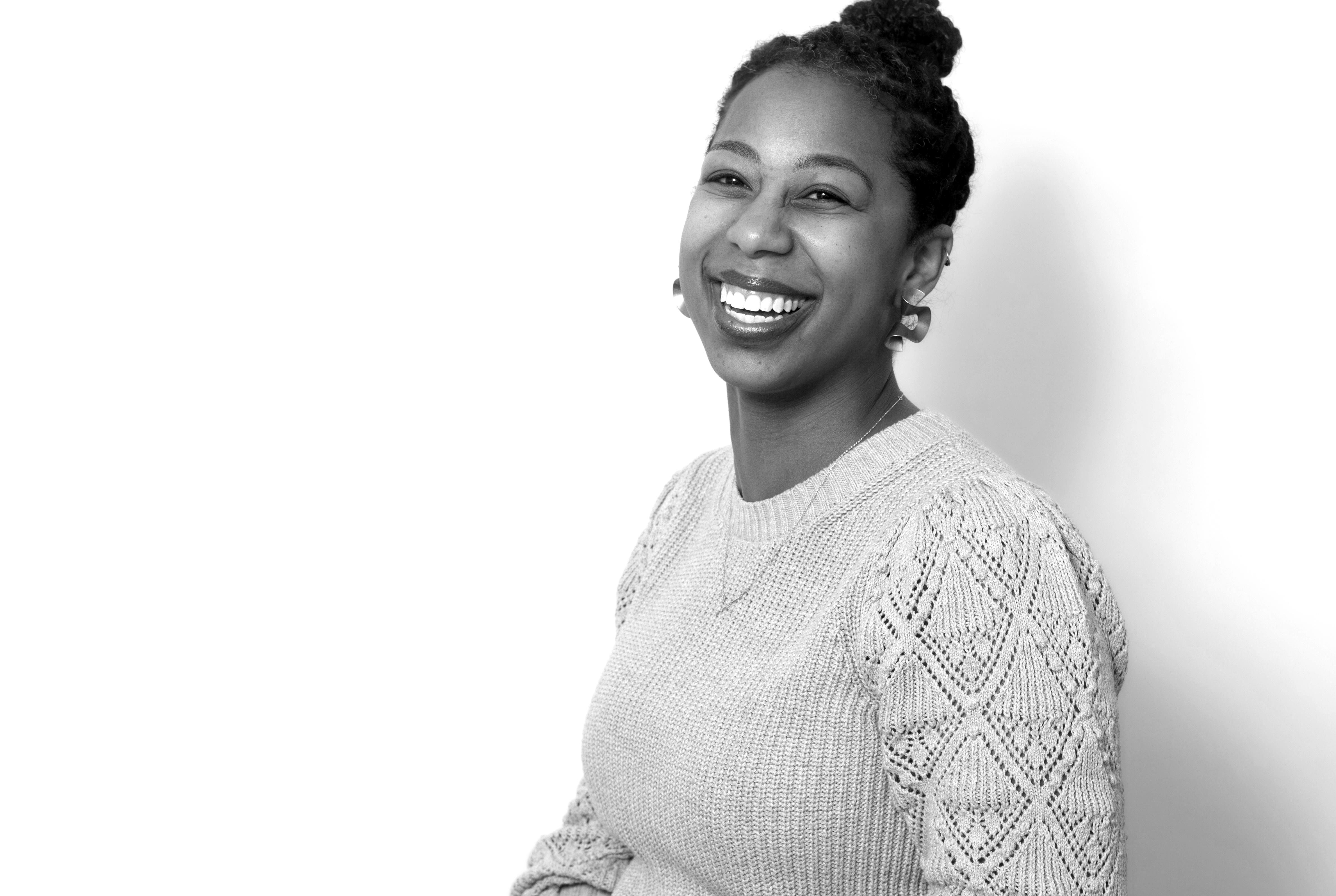
Chet’la Sebree is the author of the debut essay collection Turn (W)here: A Geography of Home as well as the poetry collections Blue Opening, longlisted for the PEN/Voelcker Award for Poetry and a finalist for both the Los Angeles Times Book Prize and the Lambda Literary Award for Bisexual Poetry; Field Study, winner of the James Laughlin Award; and Mistress, nominated for an NAACP Image Award and selected by Cathy Park Hong as the winner of the New Issues Poetry Prize. She’s an associate professor at George Washington University.
—
In Turn (W)here: A Geography of Home, we travel alongside Sebree on road trips with family and into America’s heartland, to artist residencies, visiting dear friends, and on pilgrimages to significant places of Black artistry. Through the essays, Sebree takes us beyond physical spaces: through America’s history, racism, chronic pain, and on the personal journeys toward motherhood and finding belonging. Sebree writes with authentic curiosity, taking us along to explore her own deepest questionings. When we connected over Zoom, we talked, laughed, and I found myself invited into a delightfully sprawling conversation spanning craft, art, history, motherhood, and more.
—
Jordan Bolden Majewski: Your essays move with curiosity toward new experiences. I felt like I was on a journey with you in each one toward a moment of connection more than toward an argument. Does that sound like how you think about essays as you write them?
Chet’la Sebree: One of the things that I enjoy most as a poet is to be abandoned inside something alongside the speaker of the poem. I was trying to bring that feeling to the essay form. What if I just present you with a series of experiences where I, too, don’t have the answers, but I know that I feel something here? Maybe you’ll feel something as well. In “Heart in the Heartland,” I wanted people to experience snapshots of travel around the central United States as I grappled with ideas of “heartland” and “homeland”; I wanted readers alongside me in the uncertainty. Not all the essays move that way, but I gave myself permission to wander.
JBM: Speaking of being inside an experience, you bring us into the work of many visual artists in this book. Art feels so important to this project, to you. Does visual art factor into your writing practice?
CS: Going to an art museum has always been a way for me to feel creatively fulfilled, inspired, rejuvenated, to step outside of my own brain. It’s what I do when I need to get out and reset and settle in my body. I lived in DC when I was broke in my early 20s, and those Smithsonian museums are free, so I spent a lot of my time wandering those just for something to do. When I was working on my first book, the work of Alison Saar—whom I write about in this project—really transformed how I was looking at Sally Hemings and helped shake the cobwebs loose in my mind. I try to move through life willing to step outside of myself into someone else’s externalized way of seeing the world. Sometimes we intersect, and I really vibe with the art. Other times—there’s an abstract series of paintings in conversation with the Stations of the Cross at the National Gallery of Art—I don’t understand what I’m seeing there, but I can sit and crinkle my eyebrows and think. And I love that feeling as well. So visual art is important to my practice as a scholar and as a writer, but also just as a human.
JBM: I loved your description in “In the Gallery of Good Hurt” of yourself as “someone interested in the intersection between past and present through research and art.” It’s a fascinating self-identifier, and I wonder if you could talk about your role within that framework and where you find yourself in that intersection.
CS: Part of it is that I’m such a nerd. I love research, I love history, and I love art as an expression of a particular place, time, or person—as this beautiful artifact of time and space. But I wonder if I can ever look at something from a single vantage point. Is Alison Saar having a similar conversation that Black sculptors in the 1800s were having? The current political moment, for instance, reminds me so much of the end of Reconstruction and the beginning of Jim Crow. The Reconstruction Era built all of these infrastructures for free Black people in the United States who gained citizenship. Then, with one shift in government, Rutherford B. Hayes dismantled everything, making way for Plessy v. Ferguson to give way to “separate but equal,” which became the Jim Crow Era. When people can’t believe this current political moment is happening, I’m thinking, this already happened. And so for me, the intersection of past and present is so important in understanding how we continue to move forward and learn from the things that have already happened as opposed to being shocked that they’re happening and potentially repeating the same mistakes.
JBM: In this book, I felt you acting as a parliamentarian of Black womanhood, ensuring an archive of that experience. It seems like stewardship is important in your work as well.
CS: One of my good friends, Niya Bates, is a public historian, whose work is to translate historical records for public consumption. I’ve learned a lot from the meaningful work she’s done, and it’s a gift to produce work for the public. If I’m lucky enough to continue to write and publish, then what can an archive of my work demonstrate about this moment? I feel a responsibility as a Black woman to do what Toni Morrison did for me when I read The Bluest Eye for the first time as a teen and thought, “Oh, I see something here that I feel, understand, and experience as a Black girl growing up in predominantly white spaces.” How can I be that for another Black girl moving forward?
JBM: That definitely comes through.
CS: Not to liken myself to Toni Morrison, by the way. I’m just saying I want to do a small thing for someone else as well.
JBM: [Laughter] I felt that! On the topic of cross-generational care, one of the threads weaving this book together is your journey toward motherhood. I was so interested in the way you chose to enter motherhood through generational study and epigenetics. You write, “in our wombs, in our blood, we are still following the condition of our mothers.” It ties into the historical context we’re talking about, but then brings in this real vulnerability with motherhood. Can you say more about what that meant to you?
CS: When I started the book, I had recently reckoned with the fact that I wanted to be a parent and that I could do it on my own, but realized I didn’t have a sense of where “home” was. There are so many other things—genetic, epigenetic—that I have no choice to pass on. And I asked myself whether I wanted to pass on this sort of rootlessness as well. And even though I wrote that into the proposal, I was surprised how much motherhood emerged. I told my editor, Maya, “Everything’s coming up, baby!” I couldn’t figure out the arc of the Baldwin essay (“Le Jardin Des Arts”) for so long, until I realized, “Oh, I’m not writing about Baldwin… I’m writing about family and asking, where do I want to create mine?” My plans [for parenthood] flooded the book in a way that I hadn’t anticipated, which I love. I love when a book surprises me.
JBM: The book is grappling with that vulnerability as it happens. Explicitly in “Le Jardin Des Arts,” you talk about the impossibility of holding a public self and a private self. How did you move through that and turn to public vulnerability all the same?
CS: I find nonfiction terrifying. In poetry, there’s so much scaffolding and intentional distancing. You can always say it is the poem, not the poet. Nonfiction doesn’t work that way. I think I continued to enter the essays with a poet’s voice in order to give myself permission to be as vulnerable as I am. I lean into cadence, alliteration, and music to trick myself into being more vulnerable. It requires a different part of myself that, honestly, I’m still learning. But I think about why I read—to feel seen, less alone, to give myself permission. If this gives other people the space and permission, that’s what I’m doing the work for.
JBM: Another way that I saw that vulnerability coming through was in how much the body is present in this book. The essays don’t shy away from illness, fluids, fertility, all of it. We are with your body. What role does the body play in this project?
CS: As a person who’s chronically ill, I spend so much of my time feeling invisible in my illnesses or puzzling myself to make other people comfortable in my discomfort. There’s so much about the body that we try to dismiss, push away, or ignore because it’s abject, it’s disgusting, it’s too personal. That builds a lot of shame and prevents people from fully stepping into existence because they’re trying to keep one part of themselves closed down. To push against that, I try to make the body exceptionally present in all my work, whether I’m talking about sex, illness, or pain.
JBM: I felt a thread from the relentlessness of illness and discomfort in the body that echoed the stress put on the body living within a racist society and constantly translating oneself as a Black woman. Those echoes made each theme more powerful in the book.
CS: I think about how fibroid tumors are more prevalent in Black women and how they’ve been tethered to stress. It’s hard to live in a Black woman’s body. And it makes sense to me that Black women are prone to certain disorders; our bodies are under constant stress. And we’re still just trying to endure, to find home, to have children or build community or look at visual art. Every day I know I’m going to walk outside and think, how are people going to perceive me? In the same way, every day I am living in a chronically ill body wondering, what’s going to happen when I put my feet on the ground? How am I going to feel in this body today? So I ask, what does it mean to live at all these ever-present intersections as I’m just trying to move through the world, make art, and live a life?
JBM: You also ask difficult questions about claiming a home. I’m thinking of “Partus Sequitur Ventrem,” which ends with “Will I tell them this is the cost of coming back home?” That felt fraught, like it was still being asked as the essay ends.
CS: So many of us have been displaced or emigrated or been enslaved; so much violence has taken place on the land over time. I want my child to know what it means to occupy space, acknowledging the heavy gravity of the word “occupy.” What does it mean for your body to be here? I want to raise someone who knows there’s a cost to every single thing that we do. It might mean they still own my mother’s Virginia property, but they will have to acknowledge and reckon with the origins of Corbin Hall at the Chincoteague Plantation, which are tethered to a legacy of displacement and enslavement.
JBM: I definitely want to talk about James Baldwin, who lives large in this book. You reference his work, you travel to where he lived. What brought you to Baldwin? What did you learn from him or how do you see his influence?
CS: There’s a way in which I didn’t understand how meaningful Baldwin was to me when I first read him. I’d read some essays here and there, but when I first read Giovanni’s Room in graduate school, I finished reading and immediately started reading it again. At that time, I wasn’t at all in a place where I was comfortable with my queerness or bisexuality. I wasn’t even fully aware of it, which made that book stick with me for some reasons I wasn’t even ready to acknowledge yet, but I was also fascinated by Baldwin orienting his whole life towards art and writing. In my late 20s, people in my life were building families, buying homes. I was underemployed and 100% pursuing writing with all abandon. I didn’t go to baby showers or weddings because I was doing residencies, and I felt I was moving in the spirit of Baldwin. Then in my 30s, when I finally had a tenure-track job and money to travel, I realized how badly I wanted to be like Baldwin—to have an international writing life. But when I got to the south of France, where he lived for the last two decades of his life, I also realized I was asking questions about family life that he couldn’t answer for me. He loved his nieces and nephews and his community. He had a lot of love in his life. He had partnership, but Baldwin wasn’t a parent. I had questions I couldn’t ask of him anymore. What does it mean to pivot a life away from the art and towards the self? I’m not sure Baldwin ever really got the opportunity to do that fully.
JBM: I see you carrying the mantle of the work that he did holding up a mirror to America and making America look at itself and ask important questions.
CS: There was a moment in 2020 where a lot of white people in my life were suddenly aware racism still existed. I was furious. They’d really thought Obama’s presidency had somehow fixed centuries of hate. There was a frustrating way where even my questions around becoming a parent were met with their veil of whiteness. In response to my lack of surety, they’d say something like, “I know, with the climate crisis.” Meanwhile I was actually thinking, “Is my kid going to get shot on the street?” I think part of the writing of this book was me grappling with what people thought Trump changed that I needed to correct. This is not new; this has always been a problem. He has just empowered a lot of people who are already behaving this way. And this violence, this hate, this disenfranchisement—they’ve all been a part of the long project of the United States. This is not new; it’s not going anywhere. So what does it mean to try to not only survive, but thrive in the midst of what is a reality that will be unchanged in my lifetime and probably my child’s lifetime?
JBM: I once had a white friend make an aside of “when we all became more aware of racism after George Floyd.” And I thought, “We… who is this we?” You included several moments like that in this book—I’m thinking of the white woman who wants you to move for her in the museum, the teacher whose intention is to teach a lesson about the N-word and then causes harm. You stop and make us see the energy that goes into the calculation of how to respond. Especially as I’ve entered parenthood, I’ve thought more about when I move through, when I have to stop and name what’s happening. Those questions felt integral to the kind of parenthood that you’re considering. What am I saying to the next generation, what things am I allowing to pass through me, and what things are stopping with me?
CS: My mom read my book and asked me if she had known about how my teacher referred to me and two of my friends—Guyanese and Iranian—sitting next to each other in class as the “Jim Crow Row.” In truth, that teacher was one of my favorites across my K-12 education, for whatever it’s worth. I knew it was wrong then, but only in retrospect did I realize just how harmful it was. So, as a sixteen-year-old, I likely never said anything. But I would never want my child to endure that or being called the Model UN or sitting through a class where their classmates read aloud the N-word in The Adventures of Huckleberry Finn.
JBM: There’s a moment in the book where you talk about making yourself more palatable to white audiences, which struck me as incredibly vulnerable to put in a book of nonfiction, to name parts of yourself that maybe aren’t as likable. How did that feel?
CS: Awful, but I’m always trying to go for what feels the truest. I haven’t loved it about myself, but I’ve definitely done it—largely in my academic professional life. A lot of us do it; it’s a part of code-switching. Trying to make myself smaller or deconstructing parts of myself to fit a space is an exhausting practice that I’ve tried to let go of. Though sometimes, it skews the other direction where I’m so mad and I’m going to let you all know, and then everyone thinks I’m a mad Black woman. It becomes a negotiation of how much I allow myself to be fully there versus a performance that makes other people okay. I feel comfortable where I teach, but in the larger university context I’m still navigating what version of myself I am putting on. It’s a work in progress, as it is for so many of us who have corporate jobs or jobs in the academy. In the end, the honesty in the book is my way of saying, “I know a lot of y’all out here are also doing this. So I’m going to say it, which doesn’t feel great, but I know I’m not alone.”
JBM: Before we end, I wanted to ask about what being American meant to you before the project and if it’s changed at all through writing the book.
CS: That’s a great question. I say in the book, “America, land of perpetual domination, occupation.” I am part of this American project, of what we’re doing, not just on our own land, but also in projects abroad, like its funding of horrific genocidal campaigns. I hate it. But like Baldwin says, “there isn’t any other place to go.” When I started writing this book, I really took issue with that. I thought there had to be a way around it. But in writing this book, I had to accept being from this country, this place of perpetual harm, of empire and imperialism. It’s not that I can’t move abroad, but this will always be where I’m from and there’s no changing who I am. I could live abroad for 30 years, and I will still be an American in my bones because of the way this country molded and shaped me. I want to thrive here. I want to push back against this project that seeks to dismantle everything about who I am. I can make choices that are oriented towards love and beauty, toward safety and liberation. And I believe one of the vehicles for that is education.
JBM: I always like to end hearing about what someone’s working on now. So, in the language of this book, I’ll ask, where are you headed next?
CS: Chaos. I’m simultaneously working on too many things. I spent the summer in Portugal and started writing a nonfiction piece that’s looking at land and language. I’m working on a poetry collection that seems to be a little bit more about ecopoetics than any of my work has been before. I’m trying to vaguely write some fiction. But I had two books come out within nine months of each other, so I’m not rushing to do anything. I’m on sabbatical this year, so I have the year off to just think big thoughts, and play, and see what happens.
—

Jordan Bolden Majewski (she/they) is a Black queer poet and essayist living in the Bay Area. Their work explores the embodied experience of Black motherhood in its full spectrum—the many dangers, surprises, and joys—and is interested in the ways racism entangles itself in our daily routines and relationships. Her work appears or is forthcoming in The Rumpus, Callaloo, Prairie Schooner, Shenandoah, Crab Orchard Review, Torch Magazine, and The Panafold.
Next (Marianne Boruch) >
< Previous (Diane Seuss)