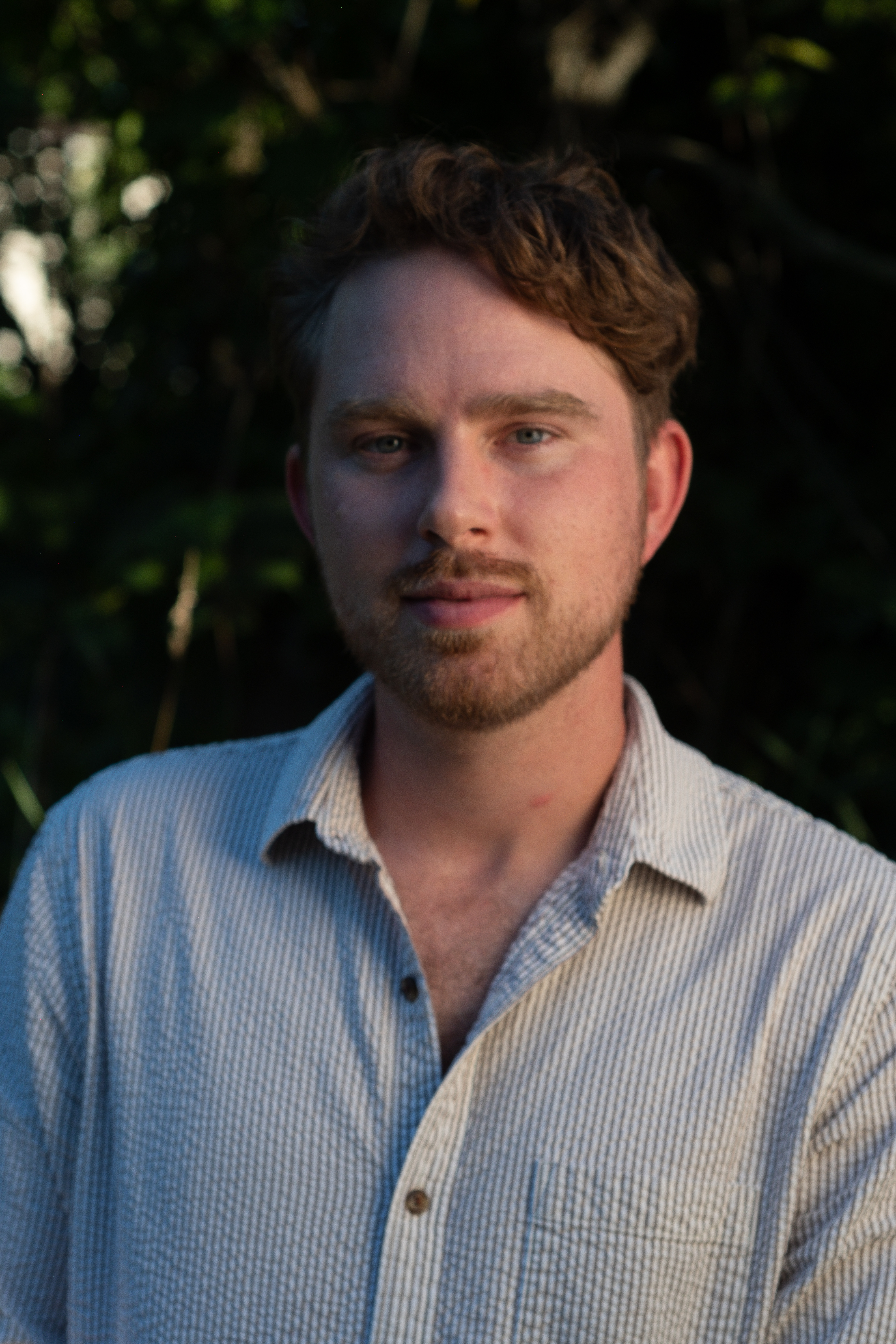
A CONVERSATION WITH ADRIAN MATEJKA
by EVAN GOLDSTEIN

Adrian Matejka is the author of eight books including The Big Smoke (Penguin, 2013), which was awarded the 2014 Anisfield-Wolf Book Award and was a finalist for the National Book Award and the Pulitzer Prize in poetry. His first graphic novel, Last On His Feet: Jack Johnson and the Battle of the Century (Liveright, 2023), was selected as one of the 10 best books of 2023 by the New York Public Library and was a finalist for the 2024 Eisner Award for Best Reality-Based Work. His selected poems, Be Easy: New & Selected, was published by Liveright in May 2026. He lives in Chicago and is editor-in-chief of Poetry magazine.
***
Evan Goldstein: Adrian, it has been a joy getting to spend time with Be Easy, which gathers 21 new poems and 83 pieces from your six collections representing a quarter-century of poetry.
I know these past few years have been full of change for you: You’re settling into your new role as the Editor-in-Chief of Poetry; you’ve moved to Chicago after living and teaching in Indiana, and now you’re publishing your first poetry collection since 2021.
This collection has a tough job to accomplish in representing an already expansive career just as you take on one of the most prominent roles in our discipline. What does this new and selected mean to you?
Adrian Matejka: First, Evan, thank you for taking the time to read the book and for making space for us to talk. I’m grateful for your care during our conversations. It’s still a little surreal for me to have a new and selected in the world. When I was coming up as a poet at the turn of the century, it seemed as though new and selecteds were for serious, capital “P” poets. Not because the poets themselves were writing with a capital “P” necessarily, but because it is a different kind of commitment for a publisher to offer a compendium of a poet’s work.
Unlike a “Best Of” music compilation where you have twelve songs from five albums or something, new and selecteds feel like a more rigorous and immersive experience. I’m thinking about Yusef Komunyakaa’s Neon Vernacular, Sharon Olds’s Strike Sparks, and Bob Kaufman’s Cranial Guitar—books that helped me to understand the arcs of the poets’ work while also helping me to appreciate the individual poems with more clarity and context. Having one of these myself still seems unimaginable.
So I’m not sure how Be Easy is sitting with me yet. I learned a lot about my own processes and proclivities while we were working on it. It probably shouldn’t have surprised me as much as it did that the things I value poetically have changed pretty radically over the past 25 years. But mainly, I’m just immensely grateful that Liveright believed in the poems enough to put it into the world. I hope the book helps to clarify where I’ve been and where I’m still trying to get to as a poet.
EG: Be Easy does a wonderful job of opening the door to the breadth of your career, starting with the cover and title. On the cover, we’re greeted with an iconic image of Diana Ross with her beautiful 70s afro; inside the afro is the cosmos. And the imperative title, Be Easy. Why open the door to this career-spanning work in this way?
AM: I love this question because titles are still the toughest part of a poem or a book for me. I mean, the title is like a shiny disco ball dangling over the poem, and if we don’t make the title glimmer in one way or another, whatever comes after is probably not going to get down the way we want it to. For me, titles need to be short, but not too short. They need to be contextualizing, but not too prescriptive.
I’m not saying this with any particular poem or poet in mind, but I’ve never responded positively to poems with “Untitled” or “Poem” up top. I mean, Frank O’Hara got away with it because he’s Frank O’Hara. But most of us don’t write with his consistent and geographic gravity. To go back to that disco ball analogy, in the hands of most poets, placeholder titles like “Poem” act like a disco ball with most of the mirrors missing. You know it’s still supposed to be a ball, it’s supposed to spin, but to what end if it’s not reflecting all over the dance floor?
But to your question about the cover art and this title, I struggled to find a phrase to introduce this project. The “selected” poems here are the versions from my reading copies. I’ve continued to revise my poems over the years for the purpose of reading them, thinking about new ways to add music or clarity when most of the people in the audience are only going to hear the poem one time. So everything I came up with to attend to the revision dimension ended up as a description, not a title—“Alternate Set List” or “Late Night Remix,” things like that. All kinds of music-based references that might have helped explain the process, but not the contents.
In the end, I tried to imagine the title in a more personal vernacular and realized the postures of the poems remind me of the sensibility of my family in the 1970s. My uncle used to say “be easy” as a salutation, sign off, encouragement, and admonishment depending on the moment, and that’s how I think of poetry generally. How we take the language depends on the moment, and that’s how the cover art worked as well.
The image is by my friend Nicholas Galanin; he created it after reading the new poems for the first time. There is some sonic overlap in our work because he is a musician (his band Ya Tseen is on Sub Pop Records) in addition to being a brilliant visual artist. Nicholas made several different images that all orbited some beautiful confluence of Diana Ross and outer space. The one we chose reminds me of a concert poster, which is even more apt for a book that’s so preoccupied with music.
EG: You mentioned that you revise your poems by annotating during your readings, and that these edits are reflected in Be Easy. When I see a poem in a collection, I tend to think that it’s the poet’s definitive version, carved in stone. Can you say more about how performing your poems has helped shape them?
AM: John Coltrane is one of my foundational inspirations, and he had a wonderful philosophy about performance. He believed that performance was practice for future albums. So while he would play “Impressions” or “A Love Supreme” in form, he was trying out future ideas in function. Some listeners were frustrated by his improvisations because they wanted to hear the music as it was presented on the records. Coltrane’s attitude was that if you want to hear the record version, listen to the record. If you want to hear him figuring out the next thing, come to a show.
I love the idea of poems continuing to live as they are in the books, but also having an ongoing life that, maybe, helps me to write future poems. It’s all tied to performance, though. I don’t find new ideas rereading poems in my corner chair under my reading lamp. There’s no real pressure or surprise in that experience. Being in front of an audience invites so many complications—each audience is different, the time and places are different, how I’m feeling and inhabiting my own body changes, etc. So to go back to a poem with those particular pressures helps me to see the poem differently, and it allows me to have an ongoing relationship with the poems, rather than making them time capsules.
EG: I love the way your poems move on the page as well. The title poem, “Be Easy,” has a motion shared by many of these new poems, starting in a reflective present moment and then falling into a past—a childhood in the Midwest that fluctuates between idyllic, isolated, and impoverished. The speaker seems to search the past for a sense of place in the present, often arriving somewhere in between.
It begins: “Around sundown, the four lilies / still holding it down in the front yard / hang open, like the window / of a passing car on a warm day.” These sensations lead the speaker into their childhood:
Easy is all I’ve wanted since
I was a kid, cramped in summertime
Section 8: flowers everywhere,
my bird-legged brother a couple
steps back, my sister book-nosed
somewhere in the radius of us.
Just a deciduous minute for us.
No more backtalks, no more slapbacks.
Be easy, my uncle would say
when I wouldn’t stop running
in circles. Be easy, he’d say
on his way out. Just an easy inhale
I imitated before tiptoeing
through the door while everybody
else snoozed. Unlatch, run away,
& join the closest circus.
How did these new poems arise for you? How do you make your poems move so well—is it through sensation, idea, the music of the language?
AM: That is such a generous reading of this poem, and the poems in general. Thank you. I have this idea about time in a poem I’ve been trying to articulate and can’t quite express cleanly. I think poems exist in all times at once. John Edgar Wideman talks about “great time,”—something that is nonlinear and more ancestral than the Western tradition of time. It’s not quite that, but I think poems happen in the past and present simultaneously. Eliot said something about this. There’s a reason we’re supposed to talk about literature in the present tense, right? The poem is still happening, even if it was written 20 years ago. But that simultaneity extends to the poet as well. When I read a poem from 20 years ago, I’m also reckoning with the version of me that existed then.
It’s made me think about the ways we strive to be present in a poem while pulling all these decades of selves with us. No matter how amazing the old experiences, no matter how much therapy or how many epiphanies we have, we always carry those old versions inside us like some kind of psychic babushka doll. I think this past/present temporality exists with all things, including our homeplaces. That’s one of the reasons the new poems are so caught up in their own geographies.
In retrospect, before Map to the Stars, I rarely wrote about place. Coming back to Indiana meant I needed to recontextualize all these familiar streets, landmarks, summer smells, constellations … so many things that meant one thing when I was 25 and meant something completely different when I was 45. The juxtaposition doesn’t play out in the poems necessarily, but those who have been around me or around Indianapolis over the years will probably recognize the echoes.
To take this back to the new poems, I didn’t realize how much I missed Indianapolis—even as I absolutely dig Chicago—until I was revising poems for the first version of Be Easy. I ended up with a stack of 35 new poems that celebrated Lake Michigan, the Chicago wind, and the cranky 146 bus I ride to work every day right next to corn fields and ad hoc carnivals in strip mall parking lots. Like anyone who has moved to a different topography, I’m still trying to sort out the old and the new.
EG: Speaking of sorting out the old and new, I have to mention that you are probably the first poet I saw read, back when I was just becoming a poet myself, in 2014. I was a student at SUNY Geneseo, and you came to read from The Big Smoke, which was so important to me as a young poet. Can you tell us about the path you took to poetry?
AM: Man, I have such fond memories of that visit and of my earlier time on faculty at Geneseo. I’ve been lucky enough to teach at other universities since then, but none of them have matched the collective curiosity or intellectual rigor I experienced with the students at Geneseo. I’ve run across so many of the young scholars I worked with back then in the world doing great things. I’m glad we’re reconnecting after all these years.
I can’t imagine that someone encountering me as an undergraduate at Indiana would have described me as “scholarly” or “rigorous.” “Curious,” maybe, but as one of my early poetry professors confessed years later, nobody thought I was serious about poetry. I was in a band. I spent too many hours hooping at the HYER (a converted airplane hangar in the middle of IU Bloomington’s campus with ten full courts). I didn’t like British literature. I was generally bored in poetry classes when I showed up. In short, I was a disinterested student even though I cared deeply about the poetry I was interested in: Yusef Komunyakaa, Gwendolyn Brooks, Etheridge Knight, anything Harlem Renaissance, and later, anything Black Arts Movement.
In fact, I got serious about writing poems because I saw Yusef read at a coffee shop in Bloomington. It remains one of the most incredible readings I’ve seen. Not just because Yusef is a transformative reader but because he was jammed into a corner in this coffee shop with a microphone and a little speaker. It was standing room only, and even as I share this, I can remember the anticipation in that crowd. This was before Yusef won the Pulitzer even though he probably should have won it for Dien Cai Dau. I didn’t know anything about him at all at the time, but I was mesmerized and left knowing I wanted to do whatever it was Yusef did in that room.
EG: Do you remember any of the poems Yusef read that night? Also, you were in a band? What did you play?
AM: You know, I remember some of the poems Yusef read in part because they are still some of my favorite poems. He read “Blackberries,” “You and I Are Disappearing,” and “Slam, Dunk, & Hook.” I was completely floored because what he was doing on the mic was made of words, but created a tapestry of music. It was a bit like hearing a great emcee if the language was more poetic—more imagistic and nuanced, maybe, as opposed to imperative and direct. Also, the music came from the words themselves—assonance, consonance, and anaphora, for example—rather than rhyme in the habit of emcees.
In retrospect, it makes sense that I would have responded to Yusef’s musicality. I was a rapper and songwriter for our band. Which was terrible. I was pretty weak on the mic. We were thoroughly mediocre overall, but it was fun, and some of the things I learned about being on stage back then have helped me be a little more comfortable on the poetry mic.
EG: I get a sense of all those selves coming forward throughout Be Easy, especially as you throw your voice into so many different characters and personae. How do you balance poems that explore your identity with poems that explore the identities and voices of others?
AM: It’s interesting because many poets (including me) are unnaturally fixated on the idea of poetic voice. We all strive for a kind of authenticity of voice on the page, one that seems both honest and mostly trustworthy. At the same time, voice in a poem is a complete construction based on the day of the week, fluctuating language choices, sentence and line construction, what we had for breakfast, syllabic consistencies—factors few people think about in spoken, or even written, language day to day.
When I first started writing poems, I was doing it with two often competing agendas. I love wordplay and the random sounds words can make when we let them. That’s one. At the same time, I’ve always been invested in poetry as a means of communication. I want poems to be legible to others. That’s the second. Just to give an example, Robert Hayden had such an incredible balance in his work of high-level craft, intensely controlled language, and also a kind of honesty that allows for poems like “Those Winter Sundays” and “Summertime and the Living” to shine for whomever is reading them. He balances those sonics with the communicative aspects so elegantly.
So I struggled early on to move past my inspirations—and I mean that in approach and language choice—to find something that sounded more like me. In The Devil’s Garden, I’m still trying to be Yusef or Allison Joseph or Rodney Jones, all three of whom are teachers who showed me how to write narratively. There are moments where I sound like me at the time— “Autobiography as Language” is one, “Pigment” is another. “Understanding Al Green” might be a third, though we didn’t include it in Be Easy.
The Devil’s Garden is also an artifact of my evolving attitudes about poetry. It came out when I was managing editor of Callaloo, and my time as an editor there was full of epiphanies. I was immersed in the work of Bob Kaufman, Lucille Clifton, Derek Walcott, Rita Dove, and Harryette Mullen at the time. Terrance Hayes’s Hip Logic came out around then as did A. Van Jordan’s M-A-C-N-O-L-I-A, and all of a sudden I’m seeing poets who are friends and who are around my age using voice with our cultural backbeat. Terrance’s poem “Emcee” expanded my idea of a poem more than any other poem up to that point, except maybe Ms. Brooks’s “We Real Cool,” Eliot’s “The Love Song of J. Alfred Prufrock,” and Etheridge Knight’s “Feeling Fucked Up.”
I started writing my second and third collections, Mixology and The Big Smoke, at the same time in 2005, right after I stepped down from Callaloo. Working on those two books after such an immersive editorial experience allowed me to see voice as something to inhabit instead of something to manipulate, if that makes sense. In Mixology, I started thinking about my world through the lens of the language of my time the way “Emcee” does. In The Big Smoke, I was required to focus on someone else’s language and experience almost exclusively like M-A-C-N-O-L-I-A. So for about five years, I was alternating between a place of lyrical excess in poems to a place of linguistic economy, and I’ve been somewhere in the middle ever since.
EG: That struggle between excess and economy often expresses itself through form. You use a variety of forms in your work: tercets, sonnets, single-stanza poems, stepped lines, and prose poems. At the same time, your poems move to their own internal music. In “Summertime Is the Right Time,” for instance, the speaker explores a feeling of dislocation in the noise of Chicago through these delicious moments of music: there are “shimmering / oyster on lemon-kissed thrones,” in the present, but then the speaker is drawn into their Indiana youth where the loudest noise was pickup basketball, hooping:
so hard we couldn’t hear the high
hatted music of my little city over
the clang of missed corner jumpers
& their record-scratched cacophony.
That last sentence extends its music through those “c” and “h” sounds that then combine in this ironic harmony with that last word, “cacophony.” What is the relationship for you between the music and the formal constraints? How does form work in your writing process?
AM: Thanks for noticing that. I think there’s a direct sonic connection between the kinds of vowel or consonant sounds in words and their bass and treble effects. Vowels like “i” and “e,” along with “c,” “k,” “s,” and “y” sounds create a system that feels like treble while “a,” “o,” “u,” “l” “r” and those combinations sound like bass to me. So I try to play in the part of the “musical spectrum” that’s appropriate for the subject, image, or dramatic moment, and form is the backbeat for me.
I love form because it activates the long history of poetry while giving some kind of frame for the sonic play inside. While some of the conventions have changed, a sonnet today employs most of the same strategies as a Shakespearian sonnet with similar melodic fascinations. The music styles might change, but the medium endures if you see what I mean.
Beyond that, form helps to visually signify what the reader can expect from a poem. Couplets suggest a particular kind of breathiness, for example, while tercets are perfect for storytelling with their beginning / middle / end lines. Sestinas offer a kind of elliptical reconsideration of language when you recognize the repeated end words, and villanelles offer anthemic restatements once you see the refrains. Form is both an ocular and auditory manifestation of poetry.
EG: I wanted to ask about the style of your two 2021 collections, Somebody Else Sold the World and the collaborative Standing on the Verge & Maggot Brain. I feel you hit a kind of stride in these with your sonic density expressing itself through formal constraints and experiments. In Standing on the Verge & Maggot Brain, the way the long poem “Maggot Brain” mimics the movements of Eddie Hazel’s solo, packing each line with music:
Flick of empty switch:
notes conscripted
& amalgamating &
somebody out there
is looking for a place
to glitch. They throw
a protest brick made
from sound into
your amp-stack anatomy.
I’m thinking of the repeating titles and formal elements in Somebody Else Sold the World: “It Way Over Way Back Then,” which moves over couplets through question and answer, “Bullet Parts,” which disassembles the parts of a bullet across multiple forms, and the fourth “Somebody Else Sold the World” with nearly every line ending in “excuses.” In both of these collections, I feel you exploring new territory. What brought these collections into being, and how do you feel your language changed with them?
AM: You know, I wish people talked about Eddie Hazel more. He was, to me, the best guitarist of that generation other than Jimi Hendrix. He was so elastic and immutable on the guitar and, like so many artists of that time, was trying to manage a heroin addiction which is essentially unmanageable. If George Clinton (who turned 85 on July 22—shout out to the original Star Child) couldn’t put up with Hazel’s behavior, you know it must have been rough.
But to your point about the books, both were written during the pandemic, so the density that you mention was the result of the way we were all required to live. I hadn’t had that much uninterrupted time to write since graduate school, but it was an anxious and dangerous time for all of us. The only way I could mitigate all that anxiety was through writing, and I think the constant stress somehow amplified the music in both books. I started working on Standing on the Verge & Maggot Brain with Kevin Neirieter and Nicholas Galanin in 2019, but the majority of Somebody Else Sold the World was written between March and October 2020.
During the pandemic, I taught a class I created called “The Poetics of Rap” in which we studied rap lyrics through the lens of poetry. Through a strange scheduling thing, I taught it back-to-back in the summer and again in the fall. All those awkward Zoom classes about A Tribe Called Quest, DOOM, Future, Rapsody, and the rest absolutely influenced the writing of the books. I was subconsciously inspired to lean into poetic sound devices like rhyme, anaphora, and epistrophe in a way I hadn’t previously.
Somebody Else Sold the World is the closest I’ve gotten to approximating the music in my head, but it dropped during the Omicron variant, so I wasn’t really able to share the work the way I might have with other books.
EG: That sounds like such a wonderful class, and I love that your writing was influenced by the explorations you and your students made. I want to shift just a bit to talk about another rich subject in your work: athleticism. Throughout your work, we encounter poems that are deeply engaged with both the physicality and language of sports. Can you talk about this relationship between sports and language across your body of work?
AM: I love the language of sports, both within the games while we compete and what we receive from the commentators when we’re watching. The expressions are so kinetic and intertwined now, but when I was younger, they weren’t so connected. There was one kind of idiom on the court—“buckets” after a particularly nice shot; “drawers” after stealing the ball from somebody; “that was on your mama” if you wanted to be especially disrespectful. But that’s not how it was on TV.
TV commentators were still offering monotone renderings of the highlights during nighttime news: box scores, stats, etc. in a way no one ever talked about things during a game. Then ESPN became a thing in the late 80s/early 90s, and TV commentary became as dynamic as the words we used while playing. It’s all been done and overdone now, but it’s hard to explain how transformative culturally Stuart Scott was or before him, Chris Berman and Dick Vitale. Listening to them on SportsCenter or during a Big Monday broadcast was so much closer to the experience of being on the court, and it was available to everyone, even those who couldn’t get the next run at Hinkle Fieldhouse or Ben Davis High School’s outdoor courts.
So it took me a long time to write about basketball even though I was playing regularly and the vernacular was a part of my life from 1983 – 2020. When I say it this way, it sounds like an obituary, and maybe it is for my knees and joints after all those concrete-court runs. But it was mainly a challenge for me to write about hoops experiences because they were deeply personal, even as the act of playing ball is communal and in some ways, doesn’t change. When I walk into a hardwood gym now, it smells the same as it did in 1983 and, to paraphrase Gene Hackman in Hoosiers, free throws are from 15 feet out, and the rims are 10 feet high wherever you play. Some things are dependable in basketball even as the joy of the game is in how fluid and unexpected it can be, just like poetry.
Writing about boxing was a totally different thing because the language of the sport sounds almost as violent as the actions of the sport. The greats—Jack Johnson, Muhammad Ali, Marvelous Marvin Hagler, even Floyd Mayweather before he started fighting tomato cans as he tried to protect his perfect record—showed a kind of poetic elegance in the ring. For them, the real work happened between punches, kind of like how the real music in poetry happens between the words.
EG: Right—a sport can be an everyday ritual where the rules don’t change, and it can be a place where miracles happen, where politics plays out. I want to go back to your mention of Muhammad Ali. The week he died, in 2016, I was on the road, and I happened to hear a fascinating conversation on the radio: You and Sonia Sanchez talked about Ali the poet. What was it like doing that program, and to engage with the public as a sort of expert on sports and poetics?
AM: I love that you heard that broadcast. It was such a beautiful experience to be on Here and Now talking with Sonia Sanchez. I knew her poems before, of course, but I’d never met her off the page. As I recall, we talked for about an hour and a half for what ended up being about a 10-minute segment. Everything she said was transformative, both about her relationship with Ali, his relationship to poetry, and her relationship to all of it. At one point she shared that she and Ali did a poetry reading in the 1970s at the New Orleans Superdome and sold the place out. A poetry reading selling out a sports arena! What a moment that must have been. I think that ended up in the segment, but so many other jewels she dropped did not.
Our conversation typified your question about being a public expert on sports, poetry, or anything really. Every time I think I have a handle on something, I talk with someone like Mama Sonia or Haki Madhubuti or Sharon Olds or Martín Espada, and I’m reminded I don’t really know much of anything about anything. I felt that way in the moment while we were recording the show, and I feel even more like that now after getting to spend more time with Mama Sonia over the years.
EG: I loved that broadcast—it provided such a clear picture of how athletes transcend their game. I love how you talk about your fellow poets and elders here, as you often call upon different figures and personae in your work, especially transformative or revolutionary Black artists and celebrities, too: Prince, EPMD, Bob Kaufman, Basquiat, Fela Kuti, of course Jack Johnson and Muhammad Ali, Eddie Hazel, even Luke Cage. Your poems celebrate these figures, but they’re also troubled by the flattening of an artist into a symbol. How does Black celebrity inform your work?
AM: Thank you for saying this. I think we all know empirically that we’re only here because someone else boosted us, but it’s especially salient for me because I’ve been the recipient of so much support from my elders, both in my work but also in the world generally. I saw the work Toi Derricotte, Cornelius Eady, and Carolyn Micklem did to build out Cave Canem back in the early 2002 when I was a fellow, trying to figure out how to be a Black poet in the homogeneous space of American poetry. I mean, at that point, Gwendolyn Brooks, Rita Dove, and Yusef Komunyakaa were the only Black poets to win the Pulitzer Prize. I’m not sure where I would be without the work my elders and peers did to make space for my poems.
This ties to your question about Black celebrity in a way because my fascination with it stems from a similar absence. There were hardly any Black people on TV or in movies when I was coming up. Nobody would hire them or make room for their stories. To quote Phife from A Tribe Called Quest, “I’ll have you left without a job / like Isaac from The Love Boat.” There was a time when Ted Lange was one of the few Black faces on prime time TV along with the actors in The Jeffersons and Good Times, both of which were written by white writers.
There were always athletes and singers, though, so I grew up inspired by boxers like Ali and Marvin Hagler, along with basketball players like Dr. J and Adrian Dantley. Musicians, too—Prince first, then later a roster of golden age rappers like Chuck D, Big Daddy Kane, and EPMD. They were the only public representations of Blackness I saw when I was coming up in Indianapolis, so I think my fascination with celebrity—both the power of it, but also the myriad and exhausting expectations of it—was seeded back then. Which is also maybe why I’d mostly rather be in the background than in the spotlight. A Black person in the spotlight has a completely different bundle of expectations to deal with than someone else might.
EG: I am not sure if poets are celebrities anymore, but you have been a public figure in the spotlight of American poetry for decades, especially now as the Editor in Chief of Poetry magazine, where you are the first Black editor in its 100-year history. I’m curious about the relationship between your work and your poetry. I know you were teaching before accepting the job with Poetry, and that you worked as poet laureate of Indiana. How have your public positions informed your writing, and has that changed as you’ve moved from teaching into editing Poetry?
AM: For me, the public work of poetry goes hand in hand with the private work of writing poems. I use the same reservoir of creative energy as an editor as I use for teaching poetry as I use for writing poems. The challenge that presents is, my reservoir is finite, and there are days when it’s completely consumed by editorial work, just as there were days back when I was poet laureate that my creative reserves were devoted to teaching community workshops. Those outward-facing enactments of poetry have helped me to better understand what we can do as poets for our community. They’ve also made me acutely aware of the dearth of resources available to poets in the U.S.
I’ve tried as best as I can to keep the door open when I’m invited into a room while also trying to create as many opportunities for other poets as I can. Just as a small example, when I was poet laureate of Indiana, I worked with the Indiana Arts Commission and the Indiana State Library to create an archive of Indiana poetry called INverse. Anyone who was from Indiana and wrote poetry was eligible for inclusion. It was wonderful to see people who have published books and won prizes alongside poets who might have never published anything before. Poetry is meant to be egalitarian even if our current structures resist that possibility.
Because of my job at Poetry, I’m frequently asked “What is poetry?” I don’t have any better answer for the question now than I did in 1993, but I think it has to do with community and connections with other humans as much as it has to do with lineation and metaphor. It’s wild to think that I’ve been writing poems for 35 years, and I’m still trying to figure out what it is I’m actually doing.