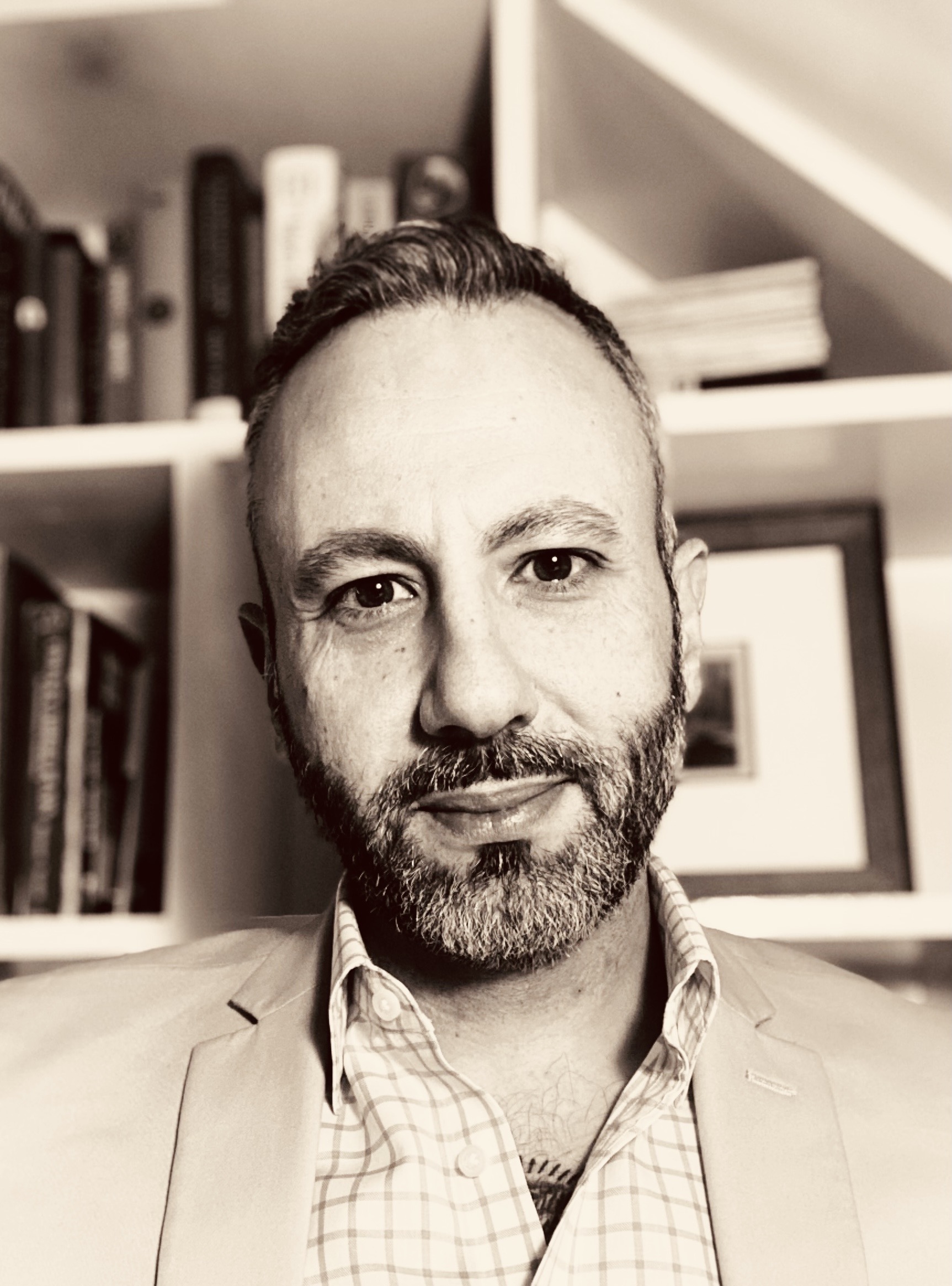
In the Blood, Pulitzer Prize winner Carl Phillips’s debut collection, was rereleased last month, over three decades after its original publication. The book signaled the arrival of a singular, new voice, introducing the syntactic sinuosity, erotic tension, mythic architecture, and moral inquiry that would come to define one of the most remarkable bodies of work in contemporary American poetry.
In this interview, Phillips reflects on returning to this earliest version of his poetic imagination: the voice he had then, the risks he knew he was taking and those he didn’t yet understand, and the ways desire, restraint, and power—so central to his oeuvre—first cohered on the page. Our conversation would open space for Phillips to consider and reconsider his preoccupations across decades, the evolution of his thinking on queerness and power, and the ongoing life of a first book that continues to reveal itself as foundational.
Issam Zineh: In the Blood was your debut. What feels most distant to you now about the poet who wrote that book, and what feels perhaps surprisingly continuous?
Carl Phillips: I guess the most distant part is my having been married to a woman and only just starting to recognize that I was gay—that’s not something I understood or even thought, really, when I got married. I don’t think I understood anything about how humans evolve and take time to sort out who they are, and that the sorting out is itself temporary, because we’re always changing. When I read the poems now, I feel how panicked I was, how painful it was—I didn’t have any queer people in my life to talk to, none that I knew of, and my best friend was my wife to whom I did eventually speak about my confusion, but we both sort of decided that’s all it was, confusion, and would somehow pass. It hadn’t changed the love between us, nor had it impacted our sex life together.
As for what’s surprisingly continuous, I suppose the fact of sexual restlessness. I had thought that would end, upon discovering my queerness. Or I thought it would end once I came out as queer and found a relationship with another man. But I think the restlessness is wired into me. It took a long time for me to realize that not everything needs to be overcome—there’s a lot we just have to learn to carry and live with, inside us.
IZ: How has your understanding of the book’s central tensions—desire, power, animality, restraint—shifted as your poetics have evolved over thirty years?
CP: I’m tempted to say there hasn’t been a shift, since I’m always interested in these tensions. But one inevitable shift is that of aging. There’s a different energy to being older. I used to assume it meant less energy, but really it seems more that energy gets used more efficiently, as if the body itself understood there’s less time to waste, and less energy to waste, so there’s no time to just wallow in desire aimlessly, for example (or at least that’s not how I want to spend my time). On the other hand, less time has sometimes meant not wanting to honor restraint so much, because why hold back when there might not be a tomorrow? Maybe it’s easier to say I’m as muddled today as I was thirty years ago. I’m always just trying to see a way clear.
IZ: The book stages desire as a kind of moral inquiry. If you were writing those poems now, what ethical questions would feel different, or more urgent?
CP: I’m not entirely sure how to answer this one, maybe because—unlike many people who have told me they always have a sense of what they’re doing in a book, and where they’re headed—I hadn’t conceived of a book of poems at all. As is the case today, I write poem by poem, not having any idea what will become of them in a larger context. The poems in In the Blood were written between 1989–1991. It was only in the summer of 1991 that Alan Dugan, with whom I’d taken some workshops locally that summer, suggested I put together a manuscript and send it to a contest. I knew nothing about such things. In a single night, I put the poems into five piles on the floor, based on general subject matter, and each had its own section. I chose five because that’s the number of acts in a Shakespearean play, and somehow I thought of my poems as being parts of a tragedy. So there was never a matter of staging desire or anything else, nor did I have any conscious ethical questions, though I now see that the staging and questions are very much part of the book. I just trusted my instinct—which continues to be smarter than I am. I suppose the questions hovering in that book are: Is it reasonable to be who and what I am? Is it my or anyone else’s fault, if there’s any fault at all? Is it wrong that I refuse to cross myself out, though I keep meaning to? What does it mean to want to cross out who we are? Guilt lies behind all of those questions, and guilt is not a thing I feel anymore, about desire or anything else.
IZ: Has your thinking changed about the relationship between watcher and watched, a dynamic that recurs throughout your work?
CP: Maybe the context has changed. In earlier years, my concern was more confined to the dynamic between hunter and prey, sometimes in the natural world of animals, and often between humans in the context of sexual cruising. Later on, this gets played out more in metaphorical restraint (as in the rope of trust binding two people together in The Tether [2001]), and later still in terms of actual restraint, the kind of BDSM imagery that comes to the fore in Speak Low (2009) and Silverchest (2013). But I’ve always also been interested in tenderness and vulnerability, what it means to watch someone sleeping, for example, and the role of power when it comes to watching someone else who doesn’t realize we’re watching them. Especially if the reason they don’t realize it is because they trust us enough not to worry about being watched . . .
IZ: Readers might notice in In the Blood the earliest sign of your signature syntactic musculature. What were you discovering about sentences then that still matters to you?
CP: Without having been very conscious of it at the time, I was just starting to feel how a sentence could enact struggle. I’m pretty sure this is tied to my having found a used copy (around 1989) of William Carlos Williams’s Selected Poems. Those were my first encounters with the idea of breaking lines up in ways that didn’t have to conform to grammatical units, and the effect of that unconformity, for me, was that Williams seemed to be straining toward utterance, toward meaning, as if not sure which parts to emphasize, or sometimes as if not knowing until that exact moment which word might be the next word. I see now that this makes sense in terms of the subject matter, in terms frankly of my mental state at the time. It was as if I’d found the music that could accommodate my restlessness and confusion. Most poets tend to deliver clear information in each line of a poem, but I’ve never been patient with that way of building a poem. It feels too much like guardrails, and there’s the safety/comfort of knowing where you are within each line—I wanted something more careening, I guess, more unpredictable and dangerous.
IZ: When you imagine the book entering the contemporary poetry landscape of 2026, are there formal risks or stylistic gestures that you think would read differently now?
CP: I think it might be the case that, because grammar isn’t taught any more, my poems might be less readable, I don’t know. Students often (even at the graduate level) don’t seem to recognize the difference between a sentence and a fragment—and a more extended periodic sentence often seems untranslatable to them, in the way that Chaucer, say, can seem to require translation, or Shakespeare can. Of course, the language changes over time, but that usually requires centuries for the language to seem foreign to us. The devolution in the 21st century has been much faster, it seems, for many reasons that are understandable even if I don’t like the situation! Just this morning, someone on social media posted some words from a poem of mine, and they posted it as a complete sentence—but it’s actually part of a much longer sentence, and just quoting the one part is both misleading when it comes to what the sentence means to say, and it’s not in fact a sentence, but a fragment excerpted from a sentence. So this might just mean that I’m not writing what the current moment requires, desires, or can comprehend. That’s when I remind myself that I’m writing what I must, for me—that’s all I knew when I was writing the poems of the first book, and that’s all I know to do now.
IZ: How did you conceive of the book’s use of myth at the time, and how has your relationship to myth evolved across your career?
CP: I was a high school Latin teacher at the time, and I taught mythology quite a bit. I talked a lot about how myths are a culture’s way of accounting for what otherwise can’t be explained in the absence of sound science. And here I was, in the midst of something I couldn’t explain about or toward myself—myth made a kind of sense, I suppose. The main example I think of from In the Blood is my use of the Leda myth in “Leda, After the Swan.” At the time, I had seen a statue of Leda being raped by a swan, and I’d read the Yeats poem. I was troubled that, in the shadow of art, somehow rape was not being seen for what it was—instead, it was being used in service to art, to philosophical reflection. I wondered what Leda would say about her own rape, which led to my writing the poem. Only later did I realize that I was partly able to write this poem because I’d myself been raped in college, though I’d never thought to say anything about it, certainly not to write about it. The combination of myth and inhabiting another persona made it possible for me to get closer to how I had felt, psychologically, in the wake of my own rape. Likewise, it was easier for me to write about a nameless speaker lamenting the loss of a Narcissus figure than for me to speak about a brief but pivotal sexual relationship I had with a man around 1990. Pivotal, because it was from that period—that relationship, if it can be called that—that almost all the poems in the book emerged. My desires had mostly been abstract up until then; an actual encounter with another man felt terrifying and thrilling, and across a summer, I couldn’t stop writing poems. And after the abrupt end of that relationship (on his part), poems were my way of writing my way through what felt like an unbearable conundrum. Anyway, myth became a way to look at some of this, also a sort of screen to hide behind. Any persona would have worked, but my training had been in classics, so I turned to Greek myth.
IZ: Has the mask fallen since?
CP: Yes, definitely. Not just the use of persona, but I feel I’ve steadily moved away from the extended sentences and so-called signature syntax, though I don’t get the sense that anyone has noticed this aspect. Right after Pastoral (2000), I started thinking that the sentence-making had itself become a sort of subterfuge. I should say, though, that I didn’t just have a day where I consciously thought this and made a change, but at some point I realized the change had happened. What might seem to be baroque sentences and syntax felt to me both an enactment of queerness and a facade behind which to hide, or maybe less a facade than a means of distraction from a certain vulnerability. It’s not as if I don’t still have winding sentences in my poems, but they’re much more likely to be counterbalanced by more straightforward, cleaner sentences. I think I’ve always been about intimacy and vulnerability, but at this point there’s more of a world-weariness, I guess. The wounds are there, and I don’t care who sees them. Nor do I feel the need to make them anything other than what they are.
IZ: The animal—both literal and figurative—appears repeatedly. What work did the animal do for you then, and what work does it do now?
CP: It’s funny, I can’t remember many animals in that first book—birds here and there, yes, and there’s the reference to Chiron the centaur, half-man and half-horse. When In the Blood first came out, one review described the work as “urban,” which I found interesting, given that I’d written the book in a small town on Cape Cod. But no sooner did I move to St. Louis, an actual city, than I became fascinated with using animals in poems, maybe a response to having moved to a place less obviously populated by animals? As for the work that the animals do . . . I’m fascinated with how animal life is stripped of moral valence, at least in human terms. Two animals can mate in a field and we think nothing of it; two people do it and they’re arrested. Ideas of betrayal don’t seem to apply. From the very start, I have been fascinated by how humans are always also animals; we just happen to have laws and morals that have conditioned us to think certain things are wrong. But what are we to do when the animal part of ourselves comes to the fore? What happens when we’re in a relationship with someone and we desire sex with someone else? Why is that considered immoral, or forbidden—why do we have names for it like adultery, if we’re married? This kind of thinking preoccupied me early on, when I was struggling with my own sexuality, surrounded by people who saw queerness as perversion. Animals, for me, are the embodiment of living instinctively, and I suppose I turn to them in poems as a way to consider how society often muzzles instinct.
IZ: In the Blood emerged during a period shaped by the AIDS crisis and by evolving discourses of queer visibility. How consciously were you writing into that?
CP: Utterly unconsciously. It might be hard for people now to imagine because we’re so used to social media, etc., but AIDS wasn’t mentioned in any newspapers. It was the Reagan era; there was no acknowledgment of queer people at all in the major news venues. Later I would learn that the crisis was being well-documented by gay papers in Boston—I lived only 90 minutes from Boston, but it may as well have been across an ocean. In my small town, there was no place where I’d have found a queer newspaper. Probably around 1991, just before I came out, I learned of a mystery disease running through the gay population—by then I had moved to Boston and had more resources nearby. But also by then I’d already written In the Blood and was only a month or so from learning that it had been chosen for publication. When the book came out, some reviewers assumed it was an AIDS-related book, mainly because of the title; one reviewer said the book was about my having lost a lover to AIDS, which was not at all the case! The title is a phrase I grew up with. People would say, if you had a certain talent, for example, that it must be “in the blood,” meaning innate. And I had been wondering if my struggling with desire meant there was something wrong with me, innately. But of course the easier thing to assume about the title is that it must refer to a virus in the blood. That makes sense, but it wasn’t my intention. I don’t think it was until my third book, From the Devotions (1998), that I wrote any poem that specifically came out of the AIDS crisis—by then, I’d come out, I’d met people who had died from AIDS, I was now part of the community that had been most affected.
IZ: Was there a poem you found yourself reading in a completely new light? Perhaps one you would write differently today?
CP: There’s nothing I’d write differently—these poems are the poems they are, and I wouldn’t change them. It’s hard, though, not to see all of them in a different light, the benefits and burdens of hindsight, I suppose. It can be a bit like seeing a photo of yourself when you were suffering, and having the benefit, now, of knowing that you survived what seemed at the time unbearable. It’s sometimes hard, too, to realize how naïve I was, or narrow, maybe. One instance of this is the poem “Africa Says,” whose imagery relies a lot on a book I had just read, Jan Morris’s Conundrum, which describes her journey to Africa in the 1970s to get a sex change operation, long before there was easy access to those resources, long before society—insofar as it has—had come to include and understand trans lives. I think my poem portrays Africa and Blackness as unpalatable, something scary—as if I were buying into the depictions of Blackness in a lot of White fiction, especially colonial White fiction. Part of me says this is just consistent with Morris’s experience (though I’m only blaming myself, not her), but I also realize that how I’m portraying Blackness in that poem speaks to my own anxiety, at the time, around race—which is why there’s that sort of manifesto early in the book (“Passing”) where I boldly reject a certain Black experience being imposed on me, the Black experience of my father in segregated Alabama, the Black aesthetic—assumed as the only aesthetic—that I first encountered at a Michael Harper reading (the Famous Black Poet in that poem), and resisted, which makes my poem “Africa Says” an accurate enough reflection, again, of my state of mind at the time, but it’s hard now not to see it as problematic.
IZ: Do you think In the Blood contains the beginnings of later poetic gestures for which you’re now known? Or does it belong to a different lineage altogether?
CP: Well, you mentioned syntax earlier; if syntax can be a poetic gesture, then that’s definitely there, and it has become the main thing people comment on about my poems, for better and worse! I guess the difficulty with this question is that I’m not all that aware of particular poetic gestures that I employ—I guess there’s the use of myth, but I mostly stopped using myth around my fourth book, I think I’d just started to find it predictable. One thing that doesn’t really happen in the first book, but which I guess is a signature thing I do, is the constant hovering between certainty and doubt, the way I don’t seem to be content to land on one idea before questioning that same idea. I think it might just be that I grew up—as kids we’re told the world is sort of fixed, there are rules, there are ways to be a human correctly, but of course that’s not true, and I have come to question all authority, including my own. Even that, though, isn’t all that unique, since I grew up in the sixties, when questioning authority was behind so many countercultural movements. But it’s one thing to be told to question authority, and another thing to have lived long enough to never trust it.
IZ: If you think of In the Blood as a threshold text, what door did it open for you technically, emotionally, ethically?
CP: I guess it opened a door, emotionally, to my being honest about sex and desire and my relationship to them. And I think there’s the start of my interest in morality here—though people focused on the sexual aspects of the book at the time, I still see myself as a philosophical poet, I just happen to include sex as a subject to be philosophical about. So maybe that answers the ethical part of your question. As for the technical aspect—I’m really not sure. I was trying on a lot of different stanzas and shapes, but somewhere in there they all have in common a fascination with sentence making, and with the sentence as a muscular tool, though I wouldn’t have thought to call it that at the time . . .
IZ: The way your body of work has been described over the decades, an argument can be made that some consider you a canonical poet. I was looking back on a conversation we had in 1998 in which you say “I’m all for having a canon.” In that conversation, I also see the seedling of what would later become more fully fleshed out in your essay “A Politics of Mere Being.” The idea of the canon is, of course, fraught cultural and political territory. I wonder where your thinking on literary canons is now.
CP: The only reason the idea of a literary canon has been so fraught, culturally and politically—and what we’re really talking about is the so-called Western canon—is that it assumes whiteness is where excellence begins and ends. So the canon was largely texts by white authors, or by a handful of non-white authors whose work adhered to the standards set by the canon. In poetry, that standard is often in terms of prosody—another field “defined” by the white tradition, a tradition that assumes iambic pentameter, for example, as music, but can’t recognize or won’t acknowledge the music in the repetitions and variations of a blues stanza. That canon also has an aversion to any discussion of non-white, non-straight identity because the tradition assumes whiteness and straightness as the default context for any piece of literature. My thinking today is that any canon needs to be elastic, to match an elastic definition of literary excellence. I carry my personal canon with me in my head, poems that for me represent an art I aspire to; and because I read a lot and widely, there are always new things being added to the canon as I discover other poetic traditions and voices. I love Shakespeare, I also love Tu Fu and Audre Lorde and Joy Harjo and Jake Skeets and Adelia Prado and . . . When I say I’m all for a canon, I mean we not only should but must have a body of writing that we care about and look to as a set of models for how this art has been done across history, this art that we ourselves want to be a part of. But that canon is different for each person. There are as many kinds of excellence as there are people. A canon needs to be able to accommodate that.
IZ: If you could speak to the poet who wrote it, what would you want him to understand about the life of a first book as it continues to reverberate?
CP: Again, I’m not sure. I didn’t think I was writing a first book—which implies that I knew I’d write a second. I was just writing poems. And once the book came out, nothing changed. There was no internet, no social media, no publicity. One simply hoped to write another poem. I had no expectations whatsoever. I didn’t have anxiety about reviews because I didn’t know people reviewed poetry, especially by beginners. Also, when there was a review, it could be months before you saw it. It’s so different from now, where there’s the pre-pub rollout, the frenzy of unboxing videos, of pub day blitzes across social media sites, etc. I think it must be a terrifying thing to have a debut book out now. For me, it was very quiet. I was invited to the publisher’s offices in Boston, where I was living, and they had some cake and champagne for me. There were maybe five of us there, and after the celebration, I walked to a bus stop and went home to my apartment. I was a student again at that point, and there was tomorrow’s class to prepare for. I had no idea that this little book was about to change my entire life forever.
***