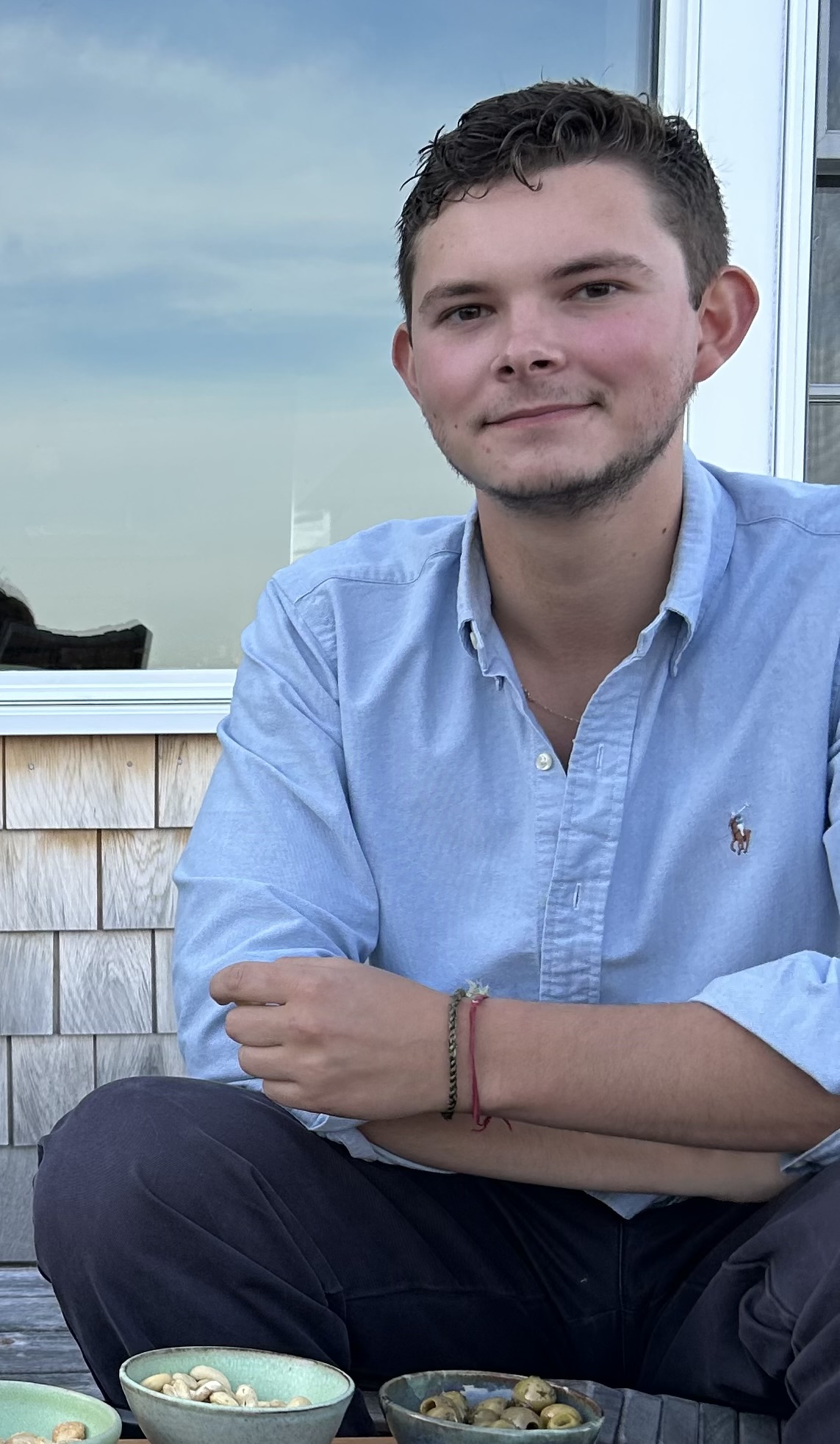
Richie Hofmann is the recipient of a 2025 Guggenheim Fellowship and a 2025 Literature Fellowship from the National Endowment for the Arts. His poetry appears in two previous collections, A Hundred Lovers (2022) and Second Empire (2015), and in The Paris Review, The New Yorker, Poetry, and The Yale Review. His honors include the Ruth Lilly Fellowship from the Poetry Foundation and the Wallace Stegner Fellowship from Stanford University.
BM: I want to congratulate you on The Bronze Arms. Reading it, I was under a complete spell. I was in the world of it. I had to reemerge back into my own world. It felt like the real thing to me—real poetry.
RH: Well, I aspire to write real poetry! I love poetry that’s an event of language, where you feel like the atmosphere changes when you read the poem. I think we prize, in our literary culture, poetry that feels natural and speech-like. And I love that too, and certain people are very good at it. But I also love poems that feel like poems, not in a cheesy or gimmicky way, because they rehearse moves that we see everyone else doing, but that feel otherworldly a little bit, that feel, I mean, obviously understandable in language, but somehow other, somehow heightened or fragile.
BM: I come away from the collection with a loosely elemental theme, which is something I always appreciate. I’m pretty simple in that I like to be able to file a book under one of the four elements. Here almost everything is happening seaside, or in the water, or if not the water, in the rain. At the end of the poem, “Night Autobiography,” one of the double-spaced poems, the speaker is summarizing a life lived, in an important sense, by the sea:
In my short life, I’ve fallen in love, but that’s mostly it
Taken in the dark
And humiliated
By the deep sea.
But that “by” is ambiguous. The speaker could be humiliated beside the sea, or humiliated by the fact of the sea’s presence. It relates to a dilemma—whether to lump together the dominating lover with the dominating force of nature or whether nature is in fact external, the thing looking on, and making the human power games a little ridiculous, humiliating, maybe, for both human parties. I always find that ambiguous role for nature compelling, and it’s all over this book. Do you see yourself as a student of nature poetry, as its own tradition?
RH: I really never think of myself as a nature poet. I’m not a human who finds nature to be tranquil or inspiring. I don’t want to go out into nature. I have friends who want to live in the wilderness and seek inspiration there. But those natural elements are a part of the tradition of love poetry as well. It would be hard for me to separate it out. There are categories of eco-poetry, poetry that has an environmental activism somehow embedded in it. And that’s a charming notion. Obviously, we need to protect the environment. But I’m mostly trying to create an aesthetic world in any of my poems. And that’s going to be inclusive of nature. The sea in particular is one of my obsessions. I live now in Chicago on a lake, but of course it has very sea-like properties. As poets, we’re often looking to nature expressionistically, which is to say as a reflection of our inner life, and there’s such range in the sea. I mean, it’s so violent. It’s so tranquil. It’s soothing, it can be entered into, it can be waded into. But its depths are also unfathomable. There’s something about the sea that feels like an image of the human. We look to it to say: reflect me, refuse me, humiliate me, take me. It’s an element of nature where you can truly be lost in it forever. And poems are like that too.
BM: A semantic question—how are you referring to the two-to-eight-line poems, those interludes between sections in this book? In my head, I’ve been calling them fragments, maybe because of the syntax, or because I know you love Sappho.
RH: I was initially thinking of them as fragments too, but other readers have had other ideas about them. I showed this book to my friend, Callie Siskel, a phenomenal poet, before I even sent it to my editor, really early on. And she thought of them as drowned lyrics.
I wanted them to be all the way at the bottom of the page. I wanted them to feel kind of weighted. And in that way, they have a drowned quality. But my editor sees them as stumbling blocks in the wreckage of the maze that the book makes. They’re ruins, they’re fragmentary, of course. They have a different kind of voice and a different kind of typography that I hope unites the book’s interests in brokenness, in antiquity, in sinking.
BM: Two of my favorites:
in that short time when I’m not conscious
all the heads are replaced
names are scratched off of the coins
no one remembers me.
That’s one of the earlier ones. And then:
the year was a room
a noiseless maze to lose myself in
pungent stupid dream
I want to remember everything that didn’t happen
That’s one of the later ones. I think either of those would be nice for your gravestone.
RH: Oh, so we’re already thinking about my death, Ben!
BM: Or anyone’s gravestone!
RH: Well, I mean, maybe they have that inscribed kind of quality.
BM: And the fragmentary—they suggest a world that they can’t explicitly evoke and I do think that’s nice for a grave.
RH: Yeah, and they’re both about memory and not memory. Right? For me, the erotics of this book is an erotics of obliteration or annihilation or total undoing. I think I call it “unhinging” in one of the early fragments. But this idea that one can lose oneself in desire, that desire and death both have this total obliterating effect on a life interests me very much. Some people are interested in the dark sexuality of this book. And they use words like kink. That feels totally wrong to me. That sounds fun, voluntary, and like an activity or an enhancement. And I guess the sexuality of this book is a kind of desire that obliterates, that kills, that disappears a self.
BM: I mean, language of kink is very contemporary, and it involves a kind of moralizing that you don’t do. For me, the figures here are removed from time. It could be a cast of demigods on a beach acting out their dynamics that have always been genuinely—not just psychologically—dangerous. But I want to go back to the topic of the fragments, because it seems so important for this.
RH: That makes me happy, because one of my anxieties is that a reader just turns the pages and kind of skips over those poems like a block quote in an essay, especially since they’re at the bottom. I’m really interested in how readers read them. I changed them all. I rewrote those fragments. I had brought a version of the manuscript to my friend Kara Van de Graaf a couple years ago, and she understood exactly what I wanted to get across in this book thematically and vocally, but said that there was a kind of deadening texture to the longer poems. They’re interesting, but when there are a lot of them, they blend together and feel like one long poem, and a little bit watery in that way. What the book needed was a mythic texture to counteract these long—for me—poems. She said she was thinking of something like “Capriccio” from my first book. That is a very lush, romantic, intense, highly lyrical poem. There are bees and flowers and it’s got a very different kind of texture than my more recent work. And so I went to the drawing board and I tried and I tried and I tried to re-inhabit that “Capriccio” style and it was impossible. It was really embarrassing. Burn those manuscripts when you’re ready to select my tombstone. But then I had the idea, on a flight to San Francisco, in fact, to write haiku.
When you’re commuting between two cities, you’ve seen every plane movie there is. So you’re just chugging your tomato juice and typing away. And I thought, let me try something new. I’ve taught haiku. I teach haiku here at UChicago. Obviously, I’ve read thousands of them probably in my miserable career. And so I started doing that, and they all were coming out not as three line poems, but as quatrains, four line poems. I thought, well, who cares? No one’s waiting for the Richie haiku experience. I wrote 30 or so of these fragments on the plane. And I thought, oh, we can put these in and around the poems. They could be an intensification of mood in between the poems. That’s a very long-winded way of just saying that they’ve evolved over time. At first I thought of them as kind of one-off pieces, but as the book came into focus, I decided that they would be sequences.
BM: A feature of your work has always been the allure of fragments that are paradoxically more whole than things that are longer, or more complete—small, erotic details that have survived time and then that way become supernaturally powerful. Classical sculpture being particularly good at that, but all kinds of other objects too—architecture, clothing, memories. In your actual process are you actively seeking out objects? Or is it all there already in your memory?
RH: It’s both, I would say. There’s a way of living poetically that is rare, but when it happens, it’s intoxicating. Where you feel like the world is being translated through you into lyric, moments are kind of isolated. Images exist in your mind. There have been a couple of times in my life when I felt totally in tune with the world and with poetry at the same time. But as I said, it’s a rare feeling. So most of the time you’re staring at the blank page and trying to make something happen. Objects jog the memory. My hero, James Merrill, said that when he was stuck on a poem, he would look to the objects in the room as the containers for emotion. And that’s a notion I’ve really taken to heart and used as a practice. But there are also times when you’re out in the world and things happen to you and you have to write them down immediately. That’s why poets carry a notebook or have a notes app where you just, you know, you have to kind of fasten something to language immediately so it doesn’t slip away like everything else.
BM: Your philosophy of the line, as you taught it to me, is that each line should be a complete poem. In some of your poems, I get a feeling that, even in such a delicate assemblage, each line or each image is already kind of bracing to be a fragment. The thread holding them together is sometimes so delicate. Maybe that’s how our attention to poetry works anyway.
Anyway, I see that philosophy of the line in the double-spaced poems in this book, each of which are capitalized, in that they are less enjambed than the maze poems, it’s a bigger leap from line to line. The material is stretched thinner over greater spans of time compared to the sonnet-length form you were working in before this. How did you land there as one of the three general forms of this book?
RH: Well, I think they’re a reaction to the sonnets. I couldn’t stay in that form any longer. If I wanted to learn new music in my voice, I had to just keep pushing it. I like the elegance and the isolation of each line. I love what you’re saying about them being poems. That’s important to me. I think every poetic line should have balanced tension and unity. But their spacious quality, I think, gave me the illusion that I was writing longer poems and did allow me to play with time in a different way. Those sonnets I had written before were mostly also single moments. In these bigger, more spacious poems, I think I was able to think about jumps and fractures more powerfully than in a fourteen line poem with a single turn.
BM: There’s some interview with Louise Glück where she talks about how, in her earlier work, she only wrote static moments of opposition, and never narratives. She says that, at one time, she literally couldn’t make an arm move—or if it went up, it certainly couldn’t come down—and that an important development of her later career was just the process of learning to write action in time, as she would write it. As I’ve been trying to learn fiction, I’ve been wondering if that is a common challenge, for a poetic temperament—just getting through time, getting the gears to start moving. Because a paused moment, just looking at the gears, can already be so potent, and is tempting because it seems like less work.
RH: Yes—than having things actually happen. I had to take a fiction course in graduate school and we had to write a couple of pages of fiction and mine was about a mysterious couple, I think it was actually a man and a woman, which is rare for me, and they were picking up shards of brick at an abandoned glassworks factory. But that was my sense of plot. They were just picking up these fragments of brick at this abandoned glassworks and thinking about the fragility of their relationship as the wind was bending the grass. That’s all I could think of. And I remember the fiction teacher, who was otherwise quite nice, said, “I think maybe you can’t write fiction. This is truly horrible.”
But I love that poems can give you a space where an atmosphere of mystery and an intensity of music can make such a simple gesture very meaningful. I love that.
BM: That kind of sounds like a story I would like. But yeah, definitely a poetic sense of time.
RH: In this book, the engagement with time was more about recollection. How do I write poems of memory that shift between time periods in a speaker’s own life; between adulthood and childhood—poems in which tense could shift. That was something I hadn’t really thought about much in my younger work—tense. I always liked the beautiful nostalgia of a past tense poem, or the immediacy and hotness of a present tense poem. But here in this book, I thought, what if I just kept switching tenses in a poem like “Drowning on Crete,” which I think encapsulates one of the central narratives of the book. There, I’m moving tenses every image, or every line, and seeing how much that stretching of time and grammar can hold up before it falls apart.
BM: Did you think of that event before—of nearly drowning in a swimming pool on Crete—as being important, developmentally? It’s the birthplace of Zeus, and, and in the collection, the poet is kind of born. It’s a transition from “When I didn’t die / And was young,” that childhood phase where you’re immortal, into danger and sexuality. But is that something that occurred to you while writing this, or is that an intuition you’d already had?
RH: It’s hard to say. I think I have a myth, a self-myth about this incident of drowning, but it truly is mythic. Like I don’t actually know if it happened. It’s one of those old stories of your life where you know the telling of the story more than you could ever remember the incident itself. And because it’s in Crete, it’s just like—you can’t make it up, it would be too ridiculous to set it in this place where they sacrificed boys in the Minotaur’s maze. So I had a hunch I wanted to write about that incident in this book. And the very first poem I wrote for this whole collection was the poem “Arms.” That was the initiating poem. I wrote that maybe nine years ago, in summer at Kenyon College. I knew that that would be something I wanted to return to. A lot of debut poets write about family and childhood in their first books, because it’s what you’re coming out of. But my first two books were about erotic turmoil and relationships, and navigating identity and historicizing identity. I’d never really written about childhood in a way that felt immediate. That was an overarching challenge in this book. How does one come into being? How does one become a self and a self that desires?
BM: That makes me think of the “Maze” poems, the four poems with that title, which are very dramatically indented and enjambed, especially compared to the other poems. They’re spoken even more intensely from within the experience of a boy or young man, who’s often making his way through frightening sexual landscapes. And yes, there’s a sense that he’s been sacrificed. Did you write all those at the same time, separate from the double-spaced poems?
RH: Yeah, I think some of them I wrote concurrently. I wrote six in order to arrive at four, which is my usual method. It’s not like I’m just high-mindedly interested in the fragment—I actually work by subtraction, write more, and then cut all of it. I write a lot of poems, and then I cut it down to the shortest book possible. The mazes came differently, because they’re not chiseled. I don’t think I’ve ever used the space of the page in quite that way before. I wanted them to have a sense of shuttling intensely, not just line to line, but within lines.
I was reading Eduardo C. Corral’s book Guillotine, which is one of my favorite books of contemporary poetry. The energy and the dynamism of his poems taught me something for those “Maze” poems. They keep bumping into walls and having to swerve away. In the first one, there’s a building with rooms we’re moving through, and the rooms are real rooms and the rooms are emotions.
BM: Your poems in general, but maybe particularly this book, evoke some fantasy for me where there’s a demise of our technology, some kind of apocalyptic return to a more elemental civilization, in which fragments of the poems or the book would remain intelligible, or might even gain in power. I know that’s an odd response.
RH: Well, I mean, poetry already enacts that primordial return because it is an unchanging art form, because emotions are unchanging. It interests me very much. You read Sappho, and she feels both extremely alien and distant, but also so familiar. Poetry already kind of enacts that apocalypse. I think it’s why we love to read old poems. They enact that apocalypse and that return from technology, while at the same time being products of technologies. And that was as true for Sappho, who, as you know, invented the plectrum for the lyre. She was thinking about new poetic technologies. Or the technology that I think about a lot today is social media, where the shape and gesture of the platform, you could say, shapes how poetry gets written and understood. I’m very interested in the Instagram square. It’s probably behind some of my interest in fragmentation on a certain level. And I’m interested in the gesture of the scroll, endless scrolling, which is probably another thing that I can’t escape as I’m making and reading poems, right? Poems can be a part of that economy, especially when they’re shared across these platforms. But also my hope for my book, for any book, is that they’re also a kind of antidote to the disposability of language, that they’re something that can be kept and returned to and slept with and called upon and reread for many, many, many encounters.
BM: I was interested in all the ghosts here, thinking of Merrill, of course, and you know, I’m always looking for something mystical or religious in life.
RH: Yes. Although—I’m so not religious in any way. I have no spirituality.
BM: But I mean, I think of you as having a belief in the real divinatory power of poetry, something bordering on the supernatural. Is that wrong?
RH: No, well, it’s not wrong. It does survive. It is immortal. That is, it does have afterlives, and I guess I’m obsessed with afterlives. But I feel very ill-suited to spiritual discussion.
BM: How come?
RH: I don’t know, I feel like what interests me most is the sensuality right in front of us. And maybe ghosts are a part of that, but it’s not that their voices are coming from other places or dimensions. They are in our dimension already. So if there is a spirituality, it’s one that co-mingles with the senses here. James Merrill, and Hervé Guibert, and all of these writers are a part of my present everyday life. And maybe that is mystical. Maybe that is a kind of mysticism.
BM: Maybe. It sounds like it to me.
RH: Okay, see, I am mystical and spiritual. I just didn’t know it! I mean, clearly I’m obsessed with ghosts. I’m obsessed with the afterlife. What does it mean to have a near-death experience and then keep going? What does it mean to find a perfectly formed bronze at the bottom of the sea, and to pull it up and encounter its intensity and beauty in another context? Like what more, what more discussion of the afterlife is needed? It’s already here. It’s just in the water waiting to be plucked, plucked out and breathed on. I’m glad you brought up spirituality. That was really fun.
BM: I’m always on the hunt for it. It’s one of those things where, in a way, it’s very against my nature, so I’m always in search of it.
RH: You have mystical experiences?
BM: Not yet. Someday though.
RH: Someday.
BM: Thank you for this conversation, Richie. Are you onto anything new yet?
RH: Well, I know what I want my next book to be about. I have my slight excitements about what’s coming. But no, I’m not working on something new yet. Right now I’m just excited for this book to be out, and to see if people respond to it. That’s the beautiful thing about having a book out. You learn things about what you did. You know, for instance, your question about being taken and humiliated by the deep sea, like—of course! Of course, the sea is one of those humiliating, sublime forces in the poem, but when I wrote it, I hadn’t thought of that. I was just thinking of proximity to the ocean. But now that you say it, of course, that is the summary of the entire book. By the sea itself. I’m like, how did I not know that until Ben read it? That’s a powerful experience, when people teach you what your poems mean.