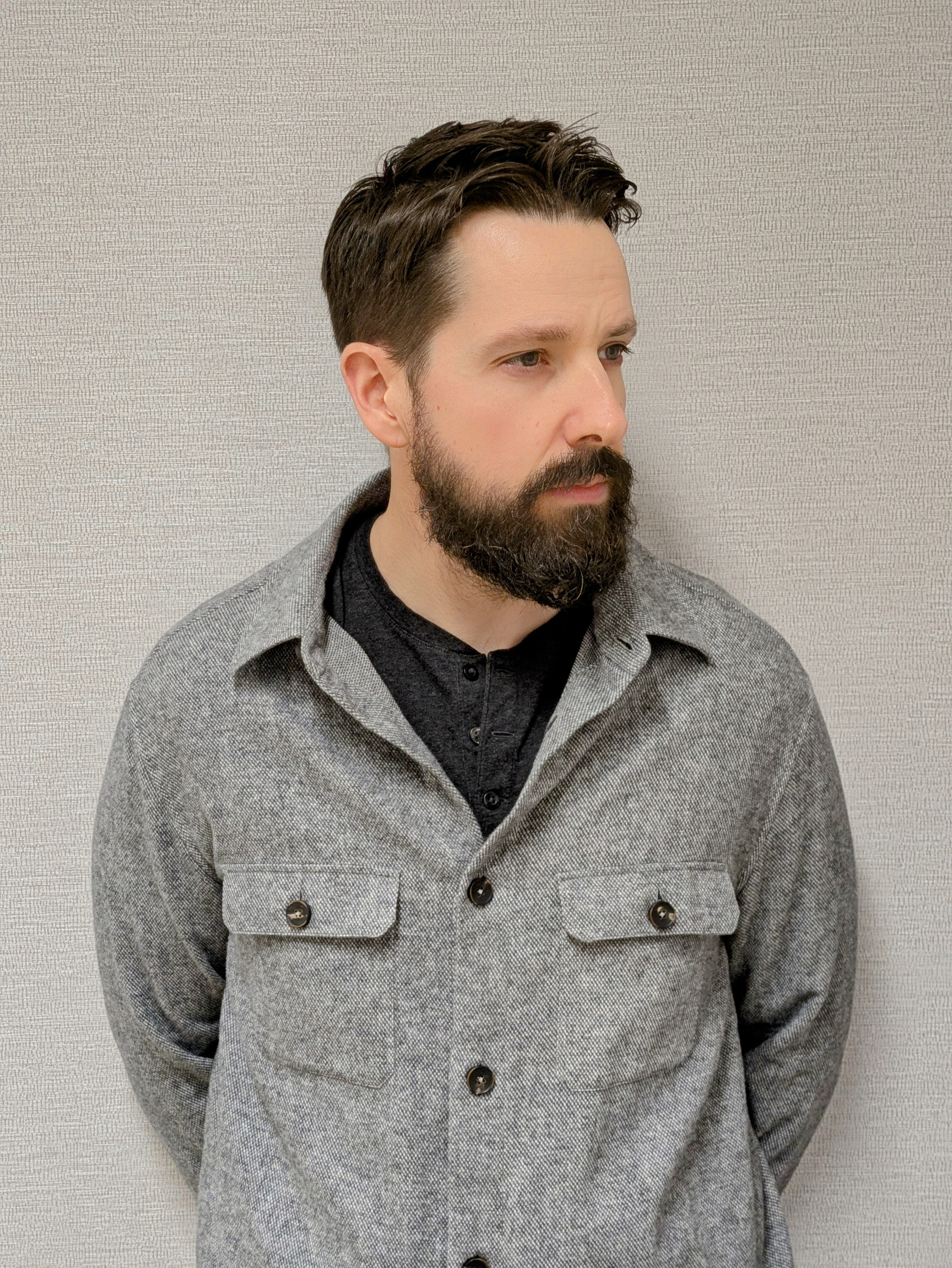
Evgeniya Dame’s “Mother, Tongue” follows two women navigating a teacher’s training college in Samara, Russia. Language sits at the forefront of the story, less a subject of study for its narrator than a kind of religion. English is her best chance of escaping her circumstances. The result is a funny, moving, and singular piece of fiction.
I’ve been following Dame’s writing for a long time, drawn to the specificity and control of her work. I was thrilled for the chance to sit down with her and talk about craft. In this interview, we move through “Mother, Tongue” from beginning to end, exploring openings, voice, structure, and the careful balance between humor and caricature. Dame, who is an editor and teacher as well as a writer, offers nuanced answers throughout, and more than once sharpened the way I think about fiction. I’m excited to share this conversation with you.
Michael Costaris: Openings are so important. I love yours. We’re thrust into this world. Everything is there in that first line. How conscious are you of the opening when you sit down to write?
Evgeniya Dame: I don’t want the opening to be flashy or engineered to hook the reader. I look for the line that works on me—almost like a hypnotist’s trigger word. They say “chicken,” and suddenly you’re out. I want to find the sentence that will transport the reader, and myself, into the world.
MC: Let’s talk about that. What a unique, specific world this is. How did you create it?
ED: The school is only a slightly fictionalized version of the school I attended, back in Samara, for five years. It was a teachers college. Every term and every rule the Coach teaches the girls in the story is something I had to learn.
MC: Did you worry readers would experience it as exaggerated—even though it’s the truth—or did you trust the specificity?
ED: I’m very aware that people might read the story and think it’s almost speculative because life in Russia tends that way. Like—why did we have massage lessons in a teacher’s college? I don’t know, but we did. I took them for six months.
MC: Let’s talk about the voice. It’s hilarious, but it never veers into caricature. How did you calibrate that?
ED: I wanted to allow the voice to be extreme and obsessive and almost deluded, because she’s focused on her studies to the exclusion of everything else. As the story begins, I don’t think she has the capacity for anything else. So I let that voice go a little bit, right up to the line of caricature. But then, in revision, I trimmed it back, both because that’s my process and because I grew to care for her. I thought she deserved some dignity in the end. As for the slightly mechanical English, I wanted to capture how my classmates talked, and how I talked before I came to the US. People always picture non-native speakers as lacking in language proficiency, but my English—and hers—wasn’t so much defective as stiff.
MC: Balance must have been a challenge. There are so many elements. Your story juggles this voice, the social hierarchy, the erotic undercurrent. Then it turns tragic. What was the organizing principle that kept it coherent?
ED: David Treuer lectured at Stanford and said something I think about often: when you work on a story, you have to be innocent about its meanings. I always start with a character trapped inside an unusual situation. Characters are the heart of the story, for many writers, and I agree with that, but I need premise and motion too. I need to know what the people in my story are doing. I like simple processes, and the massage sessions provided structure—just observing how two very different people form connection through touch. And once I had a sense of their relationship, their distinct personalities, I allowed those bigger issues into the story. Very carefully.
MC: So the theme—if we want to call it that—emerges naturally rather than intentionally?
ED: Exactly. In “Mother, Tongue,” at some point, Veronika gets pregnant. This was an organic development because my classmates would show up pregnant to graduation, because our own professors would tell us to have children early and get married—as teachers, we weren’t expected to support ourselves. So I let those realities into the story, but I didn’t set out with an agenda, much as I wanted to (my mother dropped out of her graduate studies to have me—I certainly have thoughts on pregnancy and its aftermath). And honestly, as an editor, I see this a lot: you can usually tell when a story starts with the big ideas because it sounds didactic. And I think the worst thing you can do to characters is use them as a mouthpiece for your beliefs, whether those are good or bad. Characters deserve their own minds.
MC: I used to sort of brush off when writers talked about characters writing the story for them. The spiritual side to writing. But then it kind of happened to me in my last story, and I was like . . . okay, maybe there’s something real to that feeling.
ED: As writers, we always hear about it, but it seems like wishful thinking until it happens. In this story, I can tell you the exact moment when a character said something and I thought, Where did this come from? And why is it so right? It’s when they’re talking to Henry Hopkins at the language fair, and Veronika steps in and says, “Henry, do you have children?” I forgot she was even there. I was so focused on giving the protagonist those overcomplicated show-off questions. But then I realized: of course Veronika would ask that. She is trying to figure out what it’s like to be a parent. And she’s going for the human connection, whether her language is sufficient or not, which is her throughline in the story.
MC: The small details do so much work in this. Writers are always told “build the setting,” and I often see it manifest as these tedious bouts of description. The color of the room. An inventory of the cupboard. In this, the tuberculosis shot—it’s such a tiny thing—but it instantly places us in the world in a way pages of description couldn’t.
ED: My strategy, if it can be called that, is to avoid descriptions. They don’t come easy for me. When I read Rachel Kushner or Rebecca Lee, who are very good at describing people and places, I am blown away, but I can’t do what they do, so I don’t waste page space on perfunctory description. I only go for what’s memorable, or special to me. If I’m really struggling, I’ll allow myself a cliché. With Veronika, for instance, I just gave her big eyes and long black hair, because I knew she’s the beautiful one in the story and I couldn’t think of anything else. But then we get closer and see her skin, the tuberculosis shot, and she becomes more real. I have that shot on my arm, too, by the way, as do most Russians of my generation.
MC: You use direct address—the narrator speaks to the reader. I thought it worked really well. But I’ve also seen, from bad examples, how it can easily feel gimmicky or unstable.
ED: I wrote another story before this one where the narrator explicitly addressed the story to someone. But I had to tone it down, it just wasn’t working. That’s the problem with gimmicks—they can get you the reader’s attention but they can’t make the story alive. They’re a one-trick pony and I’m very suspicious of them. In “Mother, Tongue,” the narrator isn’t consciously trying to address anyone. I think she just gets very emotional at times and has to explain herself. She is very powerless, after all. She’s not very good at expressing herself, in any language, but she badly wants to be understood. Whenever I sensed that tension building, I let it come out onto the page in the form of a direct address.
MC: I love the ending. The last line, the extended metaphor of the rain, is beautiful. But there was a line earlier I wanted to ask about: “We have no power over the moment when something enters our life.” It’s so simple, but almost seems like a thesis for the story.
ED: You know, it’s funny, because I remember planning to end with the rain metaphor, but the line you mentioned came spontaneously. It was the protagonist thinking on the page. I don’t remember writing it. It is honestly one of the big joys of writing. Margaret Atwood said that a writer is split and one half does the living, the other the writing. Which is really grim, if you think about it. But the blessing of that is when you write, another version of you emerges: it’s smarter and more compassionate, it maybe has a better grip on things than you do. Your job is to get out of the way and let it write the story.