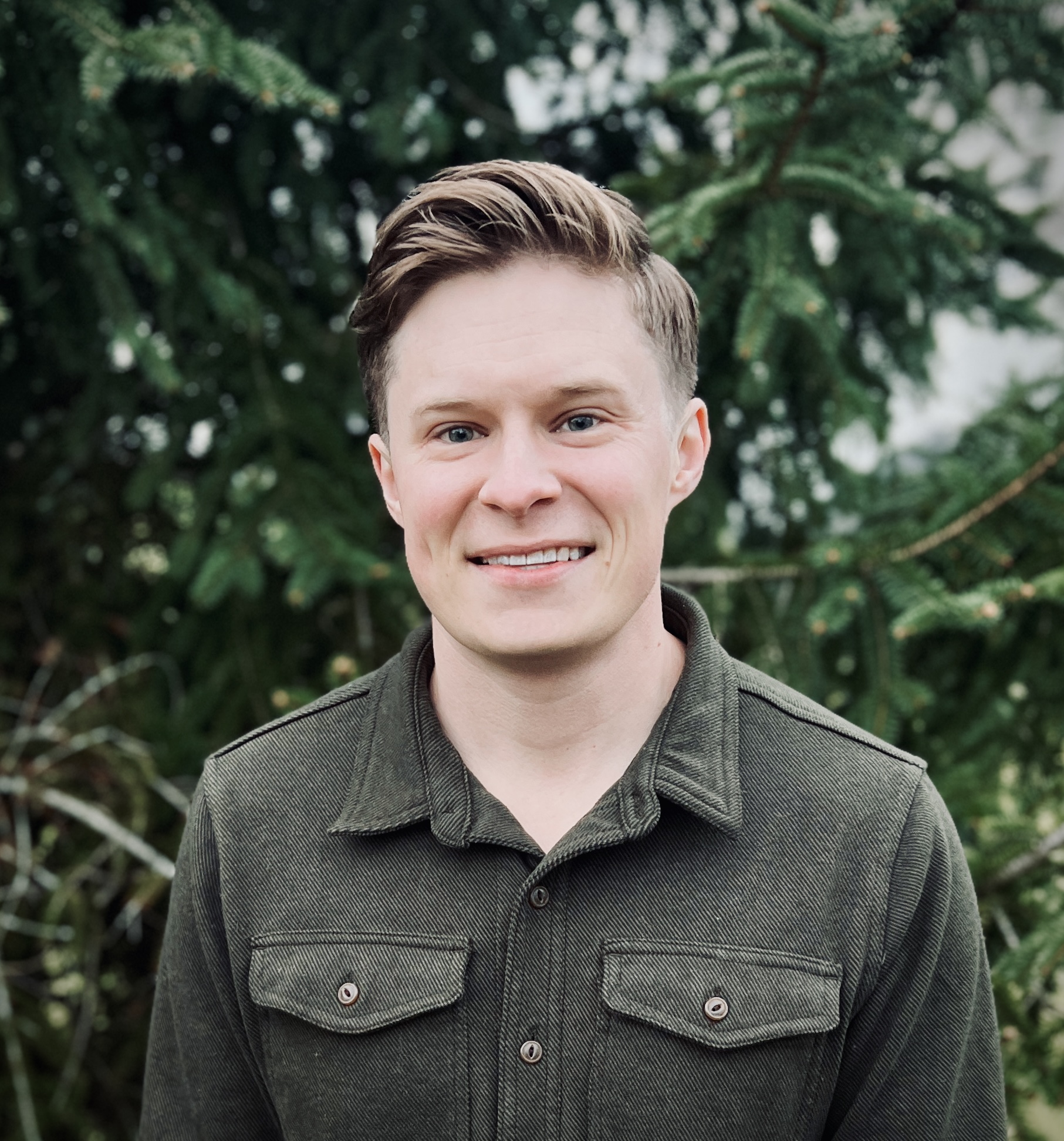
Grady Chambers is the author of the novel Great Disasters (Tin House, 2025) and the poetry collection North American Stadiums (Milkweed Books, 2018), selected by Henri Cole as the winner of the Max Ritvo Poetry Prize. His poems and stories can be found in The Atlantic, The Paris Review, American Poetry Review, Ploughshares, Poetry Magazine, The Sun, Joyland, Image, The Kenyon Review, and elsewhere. Grady is a former Wallace Stegner Fellow. He attended the MFA Program in Creative Writing at Syracuse University and lives in Philadelphia.
***
Tyler Kline: Grady, thank you for taking the time to speak with me about your marvelous novel, Great Disasters. I felt great kinship while reading your book, especially with how you deftly navigated contemporary male relationships amidst landscapes of violence, intimacy, aging, and loss. Your novel is so deeply rooted in place that I’d like to begin by asking where you found yourself writing the majority of the book. Since I know you now live in Philadelphia, was the distance from Chicago and California, two important geographical locations in the novel, both physically and emotionally significant for your writing process?
Grady Chambers: The finished book emerged slowly for me—I worked on it with various periods of intensity between 2018 and 2024, and wrote the vast majority of it at home in Philadelphia. In the midst of writing the book, I didn’t think consciously about geographic or emotional distance from Chicago (where I grew up) or California, though in hindsight I think it was actually important to be geographically removed from some of the landscapes that are rendered in the book, Chicago in particular. That distance let me feel more freedom to render the landscape, the place, the weather, the lake most nearly to the way it exists for me in memory, and I think that allowed for a kind of mythic quality to come into the rendering—the fierceness of the cold, the immense presence of Lake Michigan. And what a relief not to be physically there in the writing and therefore not have to look out the window each day to check the reality of the place against my rendering.
TK: I love how films function as impressionistic touchpoints throughout the book. Personally, I see this as the work of the poet’s brain making delightful associations and responding to the echoes of art across different mediums. I find the narrator doesn’t dwell in each reference, but much like a fleeting memory, stays present long enough to establish the resonance between art and life without having the reference oversaturate the narrative. This leads me to ask: how did thinking about film influence your storybuilding?
GC: That is such a beautiful, thoughtful observation, and it feels spot on to the reasoning behind the inclination I had to keep each dip into a film association on the briefer side, though I wouldn’t have been able to articulate why at the time. I think your insight is the answer.
As for how thinking about film influenced my storybuilding (I like that term very much): the book’s chapters—or episodes—tend to unfold in a way that I probably learned from a combination of a lifetime of moviegoing (though the structures of some books I love surely played a part as well). Each chapter or episode of the book tends to establish a “present” for the episode—a weekend spent in Palm Springs when the narrator is in college; the narrator and his friends gathering at a friend’s house on Long Island when they’re in their late 20s—before the narrator veers into memories from the past that go on to inform the present of the given episode. Films that come to mind that move or storybuild in a similar fashion are Bergman’s Scenes From a Marriage and Fred Shepisi’s Last Orders, the latter based on the beautiful, moving novel by Graham Swift. I think a lot of television series (Mad Men comes to mind) move in a similar fashion, though I watch very little television outside of a mind-numbing amount of sports, god help me, so I’m less versed, so to speak, in the world of television.
The narrator’s tendency to liken an event from life to a scene he once saw in a movie also became, for me, a way to convey the narrator as someone who has to refract experience through fictional stories, who continuously evades looking at or facing life directly by immediately turning towards the relative safety, boundaries, and containment of lives and stories depicted in films he remembers.
TK: As a follow-up, I have to ask: did your poetry brain work in conjunction or opposition to your prose brain while writing Great Disasters? Did you often find yourself turning back to verse while working on the novel? I’m curious if writing certain sections of the book required putting characters, images, and scenes down in lines of poetry first rather than prose.
GC: I was consistently working on poems during the years that I was episodically working on this novel, but they felt like two very separate endeavors, and I didn’t find myself trying to work out scenes or events in verse as a kind of drafting board for bringing them into the novel. That said, there’s a poem that I published in North American Stadiums (“Stopping the War”) that touches on events that are more fully evoked in the novel, though I wrote that poem a couple years before beginning the work of the novel. It’s fair to say, though, that in that poem I began to tell, in verse, an abbreviated version of part of the story that is told in the novel.
And I think more generally that the years I’ve spent writing poetry helped in the writing of this book in two ways that I have some clarity on: the first one is the carry-over of the compression and economy that writing poetry helps bring into one’s writing—how to get a reader interested in a very short window of space by making them feel on solid footing and letting them know the stakes at hand, and how, in a relatively brief window, to tell a story that feels complete to a reader and, ideally, provokes some kind of emotional response. I want all those things to be a part of the poems that I write, and the general brevity of poems forces one to try and do all those things in a laughably brief amount of space. Trying to do that over so many years (while often coming up short) surely helped in writing this book. Sound and sentence rhythm, too: those were things that I labored to bring into my poetry for a long time, and I found that when turning to prose, those elements kind of made their way naturally into the prose, likely from all the time I spent trying to consciously bring them into my poems.
TK: I was told by a mentor that a novel is the ideal container for one’s obsessions. I’m sure I place things I obsess over in my poems, but a novel does seem a more suitable space to let these topics percolate and develop. Did you find that to be the case when writing Great Disasters compared to how you construct poems?
GC: I did find that to be the case. And I also just had so much more fun writing prose than I tend to have while writing poems. The broader canvas prose affords allowed me to get absorbed in the world of the writing in a way that just doesn’t often accompany working on poems, for me, where I’m so attuned to tone, sound, balance, etc., that I probably spend more time thinking than I do writing.
TK: I’m extremely interested in the male relationships that exist in Great Disasters. Writing authentic, contemporary male friendships is a steep challenge, but you do so with beautiful dexterity and vulnerability. As a writer myself who explores topics of gender and the deconstruction of toxic masculinity, do you find your novel to be in conversation with these topics and to what degree?
GC: I think it is very much in conversation with those topics, but that the book itself says more about them than I as the writer behind it consciously brought to it. What I mean is that I wasn’t telling this story as a vehicle for exploring gender and masculinity, but in telling a story focused on a bunch of hockey-playing boys in early 2000s wartime America, an exploration of those topics naturally emerged. And, as sometimes beautifully happens, what the book has to say about the topics is probably more nuanced and articulate than any take on them I as the writer behind it might try and formulate outside the realm of the story.
TK: To me, Ryan’s character is one of the most genuine case studies of boyhood and male fragility I’ve encountered in some time. In fact, most of the male characters seem to function as case studies to the narrator, who is both deeply connected to the lives of each boy but at times starkly distant. I wonder if you could speak to how you envisioned Ryan’s development over the course of the novel.
GC: Ryan is a character who possesses some external signifiers (cis-het male, athlete, heavy drinker, military) that tend to trigger a set of pre-conceptions or assumptions in those who encounter a person with those signifiers. At the start of the book and through its middle, Ryan generally embodies many of the assumptions those signifiers might trigger, but as the narrator gets older and grows more distant from Ryan, he paradoxically comes to learn more and more about Ryan’s life through conversations with others, and comes to understand Ryan as a much more nuanced, compassionate, and caring person than both the Ryan he knew and that Ryan’s external signifiers sometimes suggest to people. As I wrote Ryan’s character over the course of the book, I wanted to explore the tension between the easy assumptions we tend to make about people based on external badges they embody and the inevitably much more nuanced person behind them; in short, to have Ryan be a character as complex and surprising as I generally experience people to be.
TK: The backdrop of the Iraq War is very poignant, almost like there’s another character haunting the book. I found this to be very symbolic in accordance with how the boys exist in a landscape of violence, loneliness, and self-discovery, both physically and emotionally. I’m curious how you navigated the genesis of these characters in such a fraught time period. Did you consider rooting the novel solely in the 2020s?
GC: You know, I didn’t really consider rooting the novel solely in the 2020s. From the get-go it felt important to me to have the characters be coming of age when they did—their high school years being 2001-2005—exactly because of the fraught global-political backdrop of those years. I was interested in the interwovenness of those two things: the fragility of coming of age, of becoming (a fragile, confusing, vulnerable thing at any time) coupled with doing so at a time when such large-scale events were happening and when young people—at least these young people—were feeling social and familial pressures to take a stance on such complex events while they were in the very midst of them, to take a stand. The 2020s of course has had no shortage of domestic and global fraughtness (good god) but I came of age in the same context as the characters in the book, and it was helpful to draw on the haze and confusion that I remember from my own life in those years in representing that time period and these characters moving from adolescence to adulthood within it.
TK: As a follow-up, I wonder if you consider your novel to be a political novel and, if so, in what capacity? Personally, I think of a bildungsroman or coming-of-age novel as a form that is inescapable of politics due to its definition and tradition. However, even though your novel exists in a perilous political climate—both then and now—I don’t want to pigeonhole your novel as “political.” I’m interested in your thoughts on this.
GC: I think the book is very much a political novel in the way that it presents a group of characters whose lives and actions are, to varying extents, shaped by or responding to the broader global-political realities of their time. But I also think the book enacts a kind of trick in the sense that, for me, the story at the heart of it is a much more intimate one than the elevator-pitch version of the book would suggest—a story about friendship, love, regret, and how we might better care for one another in times when we may feel powerless in the face of powerful global forces. To provide tangible, practical help to one’s friend, sibling, neighbor, or immediate community itself feels to me, in our current climate, like both a practical, humane, and political act. And lessens a bit that feeling of overwhelm or helplessness that seems to be justifiably pervasive right now.
TK: Thank you again for taking the time out of your schedule and book tour to speak. It’s been a pleasure. In the spirit of drawing connections between time, art, and space, I’d like to ask what you’re currently reading, watching, or listening to. And if you feel so compelled, I’d love to know if these connections are manifesting in any new work of yours.
GC: Two of the most remarkable, affecting works of art I’ve spent time with recently are Aamina Ahmad’s novel, The Return of Faraz Ali, and Nuri Bilge Ceylan’s film, “About Dry Grasses” (I promise the film is a far cry from the dry-ness of the translated title). Both struck me as political works that derive their considerable power not from any political statement that they make but from the human story at their core. Each is enviably compelling, deeply empathetic, wonderfully nuanced, and, plainly, beautiful.
***