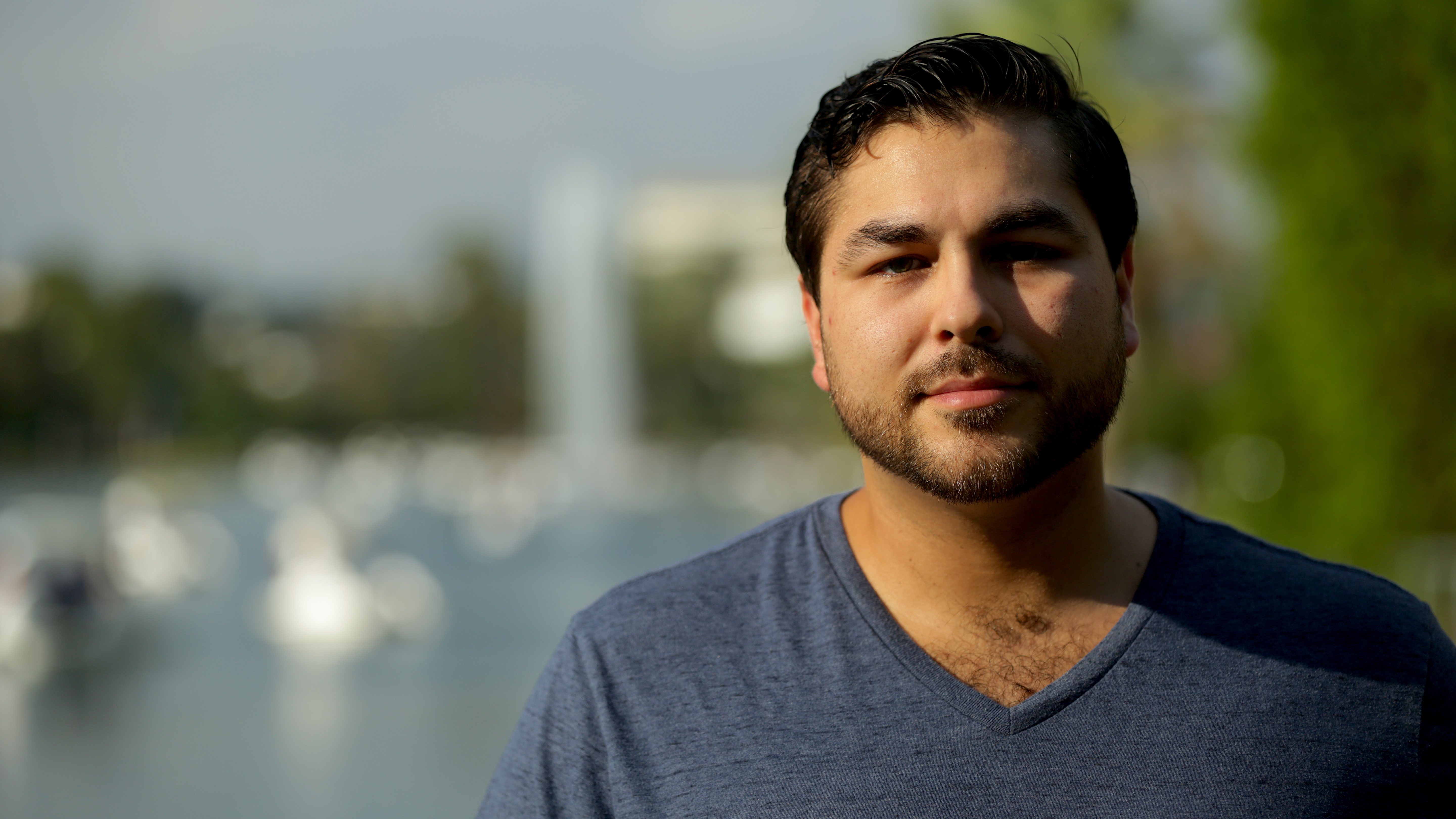
This interview took place in a courtyard outside of Varun’s Pittsburgh apartment on a summer evening in July. The sound of cicadas, crows, and blue jays called out during our conversation. Varun and I are close friends, and we have read and supported each other’s work for a number of years. Our conversation has been edited and condensed for clarity and readability.
Varun Ravindran was born in Chennai, India. His work has appeared in various journals like The Kenyon Review Online, The Adroit Journal, Denver Quarterly, and mercury firs, among others. His debut book, Betweenness, was published by Baobab Press in September 2025.
* * *
Mike Good: First, Betweenness is an incredible poetry collection—I’m struck by how it expands my notion of what a poem is, or could be—lines erupt from prose, musical scores entwine with words—so I’d like to start with a question that might seem simple, but I think is rather complicated: How would you personally define a poem?
Varun Ravindran: I don’t know. There’s different levels of recognizing what a poem is. If somebody presents me a piece of paper with text on it and tells me it’s a poem, I’d say it’s a poem. But if I write something, completely randomly and somebody says, “oh that’s a poem”—it doesn’t feel like a poem because I don’t think it’s a poem when I’m writing it.
So, when I’m writing a poem there’s a distinct sense that I am, in fact, writing a poem. This is opposed to when other people present me something and tell me it’s a poem; then I just immediately believe them. I take them in good faith. In all of the poems that I like, like Elizabeth Bishop, Derek Walcott, and John Donne—there’s always an element of surprise in them. That surprise is often a sense of play in the poem. So, that’s an element of what I look for in poems I like. But I don’t necessarily have to like them for it to be a poem.
MG: I’m wondering, what does a poem say to you to tell you that it’s done? Is there a specific feeling that helps you come to the conclusion that the poem is done?
VR: You know it when you feel it. It’s as though everything becomes clear, where it’s no longer a struggle to write the poem, because a road has been opened and all you have to do is go down. As you’re going down that road, it’s kind of this ecstatic feeling where anything can go in there. It’s like creating a recipe, and then you just experiment with it. Use different things and see what sticks. At that point, I feel confident about the direction that it’s going in, so I test it out. I see what else I can do with it, because I have the base already down, so let’s see what else I can hurl at it and see if it changes. It’s a kind of ecstatic experimentation and feeling. It sticks with me for a very long time, and it feels very good. I go through most of the day thinking, “Oh, I wonder what I should put in my poem tomorrow?” It’s very exciting.
MG: I love that analogy. And there’s a way that you talk about poetry that is interesting to me, how you’re not only surrendering yourself to the poem, but also having the confidence to feel ready to adapt it like a recipe. Knowing that you practice Zen Buddhism, I can’t help but think there’s a symbiotic relationship to that perspective. To what extent do you feel Betweenness is a Zen book, or that Zen influenced the writing of it?
VR: It’s very imprecise, but a lot of the book was written before I began practice as a Zen Buddhist. The first poem I began in maybe 2017. If you had asked me in 2017, “Are you a Zen Buddhist?” I’d have said “Fuck no.”
But now looking back, I was already on that path. Again, I can only say that now because I’m a practicing Zen Buddhist now. In that sense, if you ask me now, the book has everything to do with where I am right now, because it charted that territory. But if you asked me at that moment, even then, that’s a little bit complicated now that I think about it, actually, because what drew me to the practice was stuff that I had already been thinking about that the Buddhist text offered me words for. And so in a way, I was already—whether by nature or nurture—primed to accept Zen’s teachings. There are those seeds there even before I discovered Zen, and those seeds you can find in the book. So in that specific way, the book is responding specifically to Zen tenets.
Then again if a Zen person reads the book, and you asked them, “Is there anything Zen about this?” I feel like they’d say, “Maybe if you squint really hard, it would be a Zen book.” But they would say that about anything. They would say, for example, “If you look at a can very hard, it’s a Zen can.”
MG: You told me earlier that you grew up listening to a lot of music. I know you grew up in southern India. There, the musical tradition and tones might sound different than what is thought of in the Western tradition—with quarter tones or half tones, for example. But I notice you write a lot about some Western composers like Schubert. I’m wondering if you had any thoughts you wanted to share about how the non-Western influence of music influences your poetry or writing?
VR: There aren’t half or quarter tones in Indian music, but there is some weird stuff. The scales are unique and recognizable, and improvisation is a huge part of it. So, with what I was saying earlier about finding a “path of the poem,” that’s a lot of improvisation there.
As soon as you find the path, like these Indian classical musicians, they find a particular scale they want. Then the beginning part of their recital—it’s called an “alap”—it’s where they sound out different notes, all the different notes that belong to the scales. They really pay attention to what this tone and this scale sounds like, so if a C, D, and E-flat (those are three tones in a particular scale)—they play C, then they play D, then C again, so the two can contextualize. So then each note, it’s like you’re defining the scale and how each note relates to the other. They feel the music as it goes on, and it produces very strange, ethereal melodies. Then, all of a sudden, you’re brought back to the earth. The tempo can get faster and change. This kind of experimental, improvisational style is what I try to write in my poetry; though I don’t write about it, my method is like that.
MG: In your acknowledgments page, you talk about some of the influences on “The Age of Waters” and “At Road’s End, Lincoln City, Oregon”—specifically The Blue Roofs of Japan by Robert Bringhurst and the medieval musical form, the motet. Can you talk a little bit more about what drew you into those forms, especially for people who might not be as familiar with them?
VR: I discovered Robert Bringhurst through Patrick, my partner. Bringhurst wrote a book called The Elements of Typographic Style, which is one of the standard books when you’re studying typography. I really liked the way the book looked. Later, I looked him up, and it turned out he’s also a poet. I was super interested, so I started reading his essays, and he talked about subjects I’m also really interested in. He writes about Native Americans from the Pacific Northwest, about Coyote stories, about Raven. He writes about Buddhism. He has a lovely string of poems about the history of Zen Buddhism, writing from the points of view from famous characters and teachers from the history of Zen. I had found a kindred spirit, and I fell in love with his writing. He has also written work with multiple voices; The Blue Roofs of Japan is an example, and it’s also a work of art typographically. It requires the reader to actively participate in the poem, because it is asking a lot of the reader to imagine how these two voices would sound if there were nobody speaking in front of you. It’s almost like reading sheet music.
I’ve always been fascinated by the musical form called a fugue, where three or more independent melodic lines happen at the same time and yet they don’t clash with each other. One of my favorite composers, Bach, is known for writing so many of these fugues. This also connects me back to Bringhurst, since I was always drawn to this polyphonic music in writing, where multiple voices and melodies are happening at once.
One of my obsessions is time—and I really like the idea that to experience music, you are literally experiencing time, because music happens in time or else you’d only be hearing one note. You couldn’t connect the note C to D, which creates a melody that happens in time, without time as a medium. Fugues ratchet that idea up to another level, where each melody is working in its own specific time, and then together they create a third time, which they can only form by talking to each other.
I also like the tradition of a motet—it was a time where secular music was becoming more popular—and folk music could become the bass line, so there could be three voices where two are original and one is an inherited voice.
MG: Since the book hasn’t been released yet, we don’t have Betweenness in front of us. If we did, I feel like we’d be talking about the stunning cover on it, which you actually made yourself. Can you talk about your process in learning how to create it, and also the striking Coyote figure and its importance to you?
VR: It felt right that I wanted to do the cover. It was an idea that came into my head that I could. After living with that feeling—well, maybe it’s over-intellectualizing—maybe I just wanted to do my own cover and there’s nothing more to it.
But how I experienced it was with the idea that I may never have another book, so I wanted to give it my all. I wanted to be of absolute service to this book, because I may never ever get another chance again. So, I always try to keep that in mind. No matter how silly my idea seemed, I wanted to follow it to its end. I never thought of myself as a visual artist, but I also thought I could do my own cover to honor Coyote. Even though it seemed silly, I just made myself go through with it.
Since I’m not very good at drawing, I thought of working with linotype, and liked the idea of carving into the wood, and I’ve loved Native American Coyote art, so it was inspired by that. The book was initially dedicated to Coyote, but it is now just in the acknowledgments. As much as I love Coyote, I think he probably already knows how grateful I am to him. So, going back to how this might be my only book, I dedicated the book to my first teacher, who made me feel like a writer.
MG: Was she a grade school teacher or a high school teacher?
VR: I think tenth grade—American literature. I wrote a satire of Leaves of Grass, which I hated at that point. So, I wrote a very nasty satire, and then she told me it was “very good” and she was going to put it in front of the pencil sharpener so people could read it while sharpening their pencils. At the time, I didn’t feel moved by it, but afterwards, thinking about it, I realized that it was a really kind thing that she did, and I really needed all the confidence I could get. It didn’t hit me how much that meant to me until much later, well after I had graduated high school.
But what was the earlier question, we were talking about Coyote?
MG: Yes, Coyote makes prominent appearances in some poems like “The Age of Waters,” and I think throughout the book in more indirect ways. Coyote—as you and I read in Lewis Hyde’s Trickster Makes the World—appears in a tradition of “trickster” tales that to me suggest anything is possible, but not without consequence. The character is also very anarchic. Is that how you see Coyote?
VR: That is how I see Coyote, too, but also very human, ironically. What I mean by that is Coyote is wise but also stupid. The humans who encounter Coyote in these myths know that he’s a bit dumb, but they also know what power he has. So that’s always been a nice poem trigger for me. Especially now, people might look at a poet and say, “Oh, you want to write poetry and fix the world, how dumb are you?” And yet, poetry can be a redeeming and moving thing that enlightens the world. When you really commune with a poem, there’s something very magical that happens, and your world changes forever. It’s not only true of poems. It can happen when you listen to music, or when the light hits a landscape in a certain way. So the artist figure is both really stupid in one sense—living in a capitalist world where money is one of the arbiters of value—but also really wise. The sides co-exist in Coyote and so I’ve really read into him as an artistic figure and that’s one answer; and I also just really like dogs, and love coyotes. I’ve always been drawn to the trickster figures, just because of how nasty they can be, and it’s really just a chance to watch others live out just how nasty I could be and how I’d want to create that level of chaos if I could just let myself do it. Poetry is a sublimation of that need, because I can’t be messy in real life. I channel all of that energy into my poems. I really love Hermes too, another trickster figure, Anansi in West Africa—he’s a spider who’s a trickster—and then in Hindu mythology, Krishna is a trickster. I’ve always been drawn to those kinds of figures.
“A Poem” tries to ask this question: When is a poem a lie, and when is a poem not a lie? Can you even put that category on poetry, the category of truth? Can you put that on a poem, or is that working against it? This ambiguity in truth is something that the trickster figure also tries to exploit in all these mythologies.
MG: Growing up, the first language you heard was Tamil. I’m curious how that might affect writing in English. Do you think it does, or how did you come to write in English more so than Tamil?
VR: I had a very itinerant childhood. I moved from town to town to town almost every year, and Tamil was the first language I learned, but I also learned English at the same time. Most of the schools I attended emphasized English, and I started reading more in English than in Tamil, and so my English skills developed faster than Tamil. At some point, I stopped reading in Tamil, because I always spoke it, but I never had the necessity to read it. No one gave me a Tamil book in school and asked me to read it, because they assumed I might already know how to read it, that people would teach me at home or something. But at home, we just moved from place to place, and my mom and dad were working a lot, so no one really taught me to read in Tamil. I only took a year of Tamil reading, and I can still read somewhat, but I for sure can’t read a full book. Same with writing. But I can speak and understand Tamil. So most of the writing—while I didn’t write much when I was little—if I did, it probably would have been more in English, because I read so much, and all of it was in English.
MG: Is there anything else you’ve been thinking about as you go through this process with a great publisher and as you look forward to your book, as you’ve been editing and writing?
VR: It was never a dream of mine, in that I never even considered I’d have a book in the first place. What does it really mean to make art in this world, which politically and economically is getting worse and worse and not only that, what does it mean to be putting a book out in such a world? I don’t have any good answers. Maybe, people who don’t value the kind of things that I value—that’s very vague—let’s say just “capitalists” or “people in power”—they want you to think what you’re doing lacks any power and want you to feel helpless, to maintain power. And so by giving into that nihilism, am I just playing into their hands? I’ve been thinking about that, how I can take joy in this, which I do feel. How can I take joy in this without making that joy an end in itself, and making it into something entitled? It’s a very complicated set of feelings. I don’t know that I have any one answer. Or any answer.