
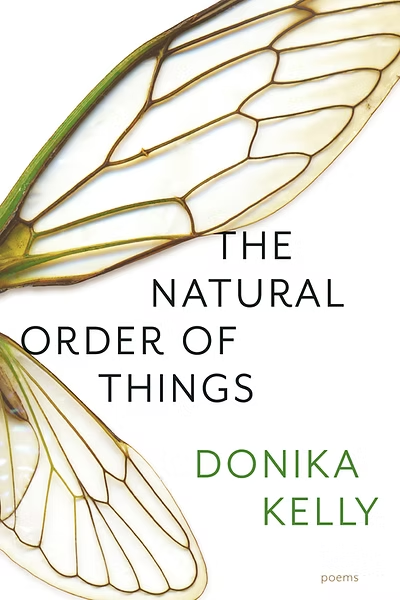
DONIKA KELLY is the author of The Natural Order of Things, The Renunciations, winner of the Anisfield-Wolf book award in poetry, and Bestiary, the winner of the 2015 Cave Canem Poetry Prize, a Hurston/Wright Legacy Award, and a Kate Tufts Discovery Award. A recipient of a fellowship from the National Endowment for the Arts, she is a Cave Canem graduate fellow and Pushcart Prize winner. Her poems have been published in The New Yorker, The Atlantic, The Paris Review, and elsewhere. She is an associate professor in the English Department at the University of Iowa, where she teaches creative writing.
*
Joanna Acevedo: If you were building a house and the only material you could use was poetry, what three poems would you use? Why?
Donika Kelly: I would build my house out of the poems I’m most often reading to my students when they are having a hard time: Mary Oliver’s “Wild Geese,” and Lucille Clifton’s “Won’t You Celebrate with Me.” I would also turn to Marie Howe’s “Magdalene: Seven Devils,” because it has helped me reconceptualize my own work and the importance of the “underneath,” the feeling or knowing that undergirds the poem, our actions, life.
JA: Who would live in your poem house? (alive, dead, in between, no holds barred)
DK: I don’t really like living with other people (my wife not included, obviously), and I wouldn’t want to conscript other poets to my aesthetic. But if I were to make a poetry neighborhood, it would be bustling for sure. I want to avoid making a list here of individual poets who have influenced me—it would be incomplete and dissatisfying, and the full list would be too long.
I will say that over the individual poem I love the book as a vessel, or to mix the metaphor, as the constellation made from the individual stars of each poem. Some of my favorite books are Lucille Clifton’s Good Woman, Gwendolyn Brooks’s In the Mecca, Carl Phillips’s Scattered Snow, to the North, Alison Thumel’s Architect, Cameron Awkward-Rich’s Dispatch, Ama Codjoe’s Bluest Nude, Marie Howe’s Magdalene, Natasha Trethewey’s Bellocq’s Ophelia, Diana Khoi Nguyen’s Ghost Of, Ladan Osman’s Exiles of Eden, and hundreds, a thousand more.
JA: How do your influences enrich your writing? How do they limit you?
DK: Poetry is old as hell. It’s one of the original human artforms. My poems are but a part of a piece of that lineage. I am so lucky to be a poet, writing right now. I’m only enriched by those who influence me because they show me that I can do whatever I want. I can deepen in my art, making it more and more itself. I can change direction entirely. I can say the hardest thing plainly. I can make the quotidian grand. All of it new and the same at each turn.
JA: How do the books you’ve written previously enrich and/or limit you?
DK: My books are not a space of limitation—or if they are, the limitation is the one found in the practice of poetry, which is artifice and shape and concentration. I love the boundaries of artifice! I have been enriched by each of my books often through being in conversation with readers who reflect back to me a book’s concerns. I discovered my interest in migration, short sentences, and the distance of the second person in Bestiary. Claire Schwartz, I think, showed me two houses that bookend The Renunciations, the field shaped eventually into pasture. In The Natural Order of Things I have my suspicions about what the poems reveal: my own search to be alongside, however and wherever possible, my family, friends, art.
JA: Do you see each of your books as a continuation of the same exploration, or a brand new question being asked, a new idea entirely? Since some themes recur, do you feel that all writers have lifelong obsessions, or do we grow as we continue to move through the world?
DK: Of course, most of us have our obsessions, the core images that help us make sense of the world, and I’m no different. Each collection is a continuation of a practice of trying to be more present, to move toward the warmth of being loved fully.
I didn’t have questions for Bestiary—just vibes and dissociation, hence all the second person. Unbeknownst to me, I was searching for new ways to be with people, trying to figure out how to set my own and respect other people’s boundaries.
My questions for The Renunciations were much clearer to me. Of the lessons my given family taught me about how to be in relationships, what did I want to keep, and what did I need to put down? Of the stories I’d told to myself about having been abused, what did I want to keep, and what did I need to put down? The project of that book was urgent and narrow, and I figured out a lot by putting those poems in conversation with each other.
There is a way that The Natural Order of Things differs pretty significantly from my other books: there are fewer birds, and more water, which makes sense. When I was writing the poems that would come to make up this collection, I was living near or traveling often to the ocean for research.
JA: What draws you to the self-portrait? Are self-portraits always about yourself?
DK: Self-portraits are a way of externalizing some aspect of myself, explicitly into figure, that allows me to understand my feelings, my thoughts, and how I came to them. “Self-Portrait as a Woman Who Kneels Over Her Beloved’s Face,” for example. How did that happen?! What fortune did I stumble into? There’s always distance between the poet and speaker, but the title creates layers of distance that extend beyond the conceit of the self-portrait that gives me a little cover from which to write the poem.
I use the third-person to describe the speaker, “a woman.” (Is that me, am I a woman? I think so, yes.) Then I use the third-person possessive, “her beloved.” (My beloved? Sure, but also as a woman with a beloved. The concept of such a person.) The poem itself is in first-person, which feels possible only because I have situated my speaker in a lineage of women who sit on their sweeties’ faces.
My self-portraits are always about me, just as all of my poems are about me. I’m the filter for my own experience. My hope is that through the self-portrait, I will come into surprise and understanding, and that I will be, to a reader, recognizable as kin.
JA: I’m curious to consider more how the tension between the two forces of self and other, connected by perception, are at play in these moments and how they push and pull at each other. Maybe I’m stuck on this idea of a visual self-portrait but I think it can apply to a poetic one as well.
DK: I see in your question a description of figurative language, which tends to yoke two unlike things to each other in service of bringing the reader closer to one of the things. Mary Oliver writes that figurative language “can make visible and ‘felt’ that which is invisible and ‘unfeelable.’” All of which is to say that the self-portrait is necessarily a figurative practice.
By invoking the language of visual art, I’m calling on a tradition of the artist trying to capture some aspect of a self in paint, photography, clay or stone, but my medium is words. I’m trying to understand something about myself by yoking the feeling (ecstasy or the sublime or fear or rage) to the practice of externalized self-reflection. I often like a “self-portrait as something or other” or “self portrait with some object or person,” which is a grounding practice, a framing one. I’m pointing to the figurative work that is happening on multiple levels, because through that figurative work, I can often get closer to a fuller, emotional understanding of experience.
JA: The animal metaphors, which give way to the transition of the body into the water and eventually a kind of dissolution, feels like a natural pattern of grief. The book feels necessary and cathartic for the speaker, but the reader feels almost too intimately involved in these bodily sensations of grief. How do you place the reader in these poems? Voyeur, companion, witness, student, necessary evil, acceptable by-product, cherished listener, satellite dish, hope chest?
DK: The Natural Order of Things is not more concerned with grief than any other feeling. The collection, in four movements, moves through my longing to be with my family in small ways I can—through our shared language, which is so rich; to be with my beloved at the beginning of the beginning to right now, love in its many ranges; to be with a person who is moved by art; to be with a good friend. I see this book working in the way I understand poetry to work: as an offering to a reader that asks, “Does this make sense? Did I get it right?” The reader is free to say yes! To say no! To be bored. The reader is free to walk away. I hope they’ll stay, though.
JA: Is your poetry house built well? Is it sturdy or flimsy? Do you rent it or have you sold it? Is there a mortgage, or roommates, is it made of glass, are you planning to burn it down?
DK: I’m really interested in the recurring motif in this interview of poetry as a house. I simply don’t experience poetry in that way. Poetry for me is a practice that is deeply integrated into my life. I teach poetry writing classes, where I get to play at making poems with my students. I do service in the community by reading various applications or judging pre- and post-publication contests. I’ve even started roping my friends into writing with me one-on-one. My practice is a joy and my most secure attachment. (Shout out to Claudia Cortese for that language.)
JA: What is one thing that everyone alive on this planet should know right now?
DK: I have no idea how to answer this question!
This is the only planet we have, the only one to which we are perfectly suited, borders are fictions, and no one is alien here.
Also, read more poetry.
*
